
Last updated July 11, 2026
Air Duct Cleaning Maintenance Checklist for Wichita Homeowners
Here’s the truth that filter manufacturers won’t put on the packaging: Wichita sits in one of the highest airborne agricultural dust corridors in the Midwest. During harvest season, a standard 90-day pleated filter is already choking by week six. We’ve opened duct systems in Riverside homes where the return trunk looked like a grain elevator. The standard “change your filter every 90 days” advice isn’t wrong—it’s just written for climates that don’t deal with Kansas wheat harvest dust, spring pollen surges, and the sudden humidity spikes that turn that dust into caked-on interior lining. This checklist is built around what actually degrades duct systems in Wichita, not generic HVAC boilerplate. You’ll learn a month-by-month task list tied to our seasonal patterns, which components you can safely inspect yourself versus what requires professional equipment, and how to spot when a maintenance item has crossed into repair territory.
Quick Answer
Wichita homeowners should inspect air filters monthly during harvest season (May–October), check visible ductwork and registers quarterly, and schedule professional duct cleaning every 3–5 years—or sooner if you’ve completed renovations, noticed persistent dust accumulation, or experienced a major storm event. A complete maintenance program combines homeowner visual checks with periodic professional cleaning using negative-pressure systems like the Nikro equipment we run on every job.
Table of Contents
- Why Wichita Ducts Degrade Faster Than National Averages
- Month-by-Month Maintenance Calendar
- Homeowner Self-Inspection Checklist: What You Can Safely Check
- Logging Baseline Observations: Measure Buildup, Don’t Guess
- Post-Storm Duct Checks: What Wichita Storm Season Does to Your System
- When a Checklist Item Becomes a Professional Call
- Common Mistakes to Avoid
- When to Call a Professional
- Frequently Asked Questions
- The Bottom Line
Why Wichita Ducts Degrade Faster Than National Averages
Three conditions specific to south-central Kansas accelerate duct contamination beyond what national maintenance guides assume. Understanding them explains why our checklist diverges from the standard advice.
Agricultural particulate load. Wichita sits surrounded by wheat, sorghum, and corn production. During harvest—typically late May through July for wheat, September through November for corn and soybeans—combines and grain trucks kick up particulate that standard HVAC filtration isn’t designed to handle at volume. We’ve pulled filters from Delano homes in mid-July that were so loaded with chaff and field dust the pleats had collapsed against the frame. The Atlas Air Duct & Vent Cleaning Kansas home service area covers neighborhoods directly in this plume.
Extreme humidity cycling. Wichita’s summer dew points regularly hit 70°F, while winter indoor humidity can drop below 20% with forced-air heating. That moisture swing causes dust to alternately cake and flake inside ductwork, creating layers that standard vacuuming won’t dislodge. In our 17 years inside duct systems, we’ve found the worst accumulation in homes where summer humidity was never addressed and winter heating dried that moist debris into a hardened shell.
Tornado season debris intrusion. Even near-miss events pressurize homes differently, forcing unfiltered air through every gap in the envelope. After the April 2022 derecho and the May 2023 tornado outbreak, we fielded calls from College Hill and Eastborough homeowners who’d never had duct issues before but were suddenly seeing visible dust plumes from registers. Storms don’t just damage roofs—they stress the entire pressure boundary of your home.
These three factors mean Wichita homeowners need a more aggressive inspection rhythm than the national “set it and forget it” approach suggests.
Month-by-Month Maintenance Calendar
This calendar aligns tasks with Wichita’s actual environmental stressors, not arbitrary dates. Adjust slightly based on your specific neighborhood—homes near active fields in Maize or Andover see heavier spring and fall particulate loads than central Wichita properties.
March–April: Pre-Season HVAC Prep
- Replace filter with MERV 8–11 pleated media (higher MERV restricts airflow in older Wichita systems without variable-speed blowers).
- Inspect outdoor condenser for cottonwood seed accumulation—Wichita’s cottonwood season peaks in late May, but early fluff starts now.
- Check bathroom and kitchen exhaust vents for blockages; spring humidity makes these work harder.
- Schedule professional HVAC cleaning if it’s been over two years. Our HVAC Cleaning in Kansas City page details what this covers for systems like yours.
May–June: Harvest Season Begins
- Switch to monthly filter checks—not replacements necessarily, but visual inspections. Hold the filter to light; if you can’t see through it, replace it regardless of date.
- Vacuum return air grilles with brush attachment to prevent surface dust from being drawn inward.
- Note any new odors when AC first cycles—musty or “grain bin” smells indicate moisture + organic particulate in the system.
July–August: Peak Heat & Humidity
- Check condensate drain line monthly—Wichita’s humidity generates gallons of condensate daily, and algae/clog backups are common.
- Inspect visible flex duct in attic for sagging or disconnected sections; extreme attic temperatures degrade connections.
- Replace filter even if it looks “okay”—summer humidity causes microbial growth on media that visual inspection misses.
September–October: Second Harvest & Transition
- Return to bi-weekly filter checks during corn and milo harvest.
- Run system on “fan only” for 2 hours after first heating cycle to clear summer accumulation from ducts.
- Inspect duct boots and registers for gaps that opened during summer expansion/contraction.
November–February: Heating Season
- Replace filter at start of season; dry winter air makes existing dust more airborne.
- Check for hot/cold spots by room—winter temperature stratification reveals duct leakage or blockage.
- Monitor humidity levels; below 30% indicates excessive air exchange, possibly from duct leaks pulling attic air.
Homeowner Self-Inspection Checklist: What You Can Safely Check
Some maintenance tasks are genuinely homeowner-appropriate. Others require equipment and training to assess correctly. Here’s the line we draw after 17 years of seeing what goes wrong when that line gets crossed.
Safe for Homeowners
- Filter housing and filter condition. Remove the filter, note the date on the frame with a marker, and inspect for collapse, moisture staining, or mold on the cardboard frame. These are all signals of system problems beyond “dirty filter.”
- Floor and wall registers. Remove with a screwdriver, vacuum the boot (the sheet metal box behind the grille), and look for debris accumulation, rodent droppings, or disconnected flex duct. In Wichita’s older homes—Riverside, Midtown, parts of College Hill— we’ve found original 1920s plaster debris still shedding into boots.
- Visible flex duct in basement, crawl space, or attic. Look for kinks, crushing, disconnected ends, or UV degradation on any exposed sections. Do not touch fiberglass insulation without gloves and respiratory protection.
- Condensate drain pan and line. Check for standing water or algae staining. A cup of white vinegar down the line monthly prevents most clogs.
- Thermostat temperature differential. Set a thermometer at a supply register; after 10 minutes of runtime, supply air should be 14–20°F cooler than return air in cooling mode. Less differential suggests coil or airflow issues.
Requires Professional Assessment
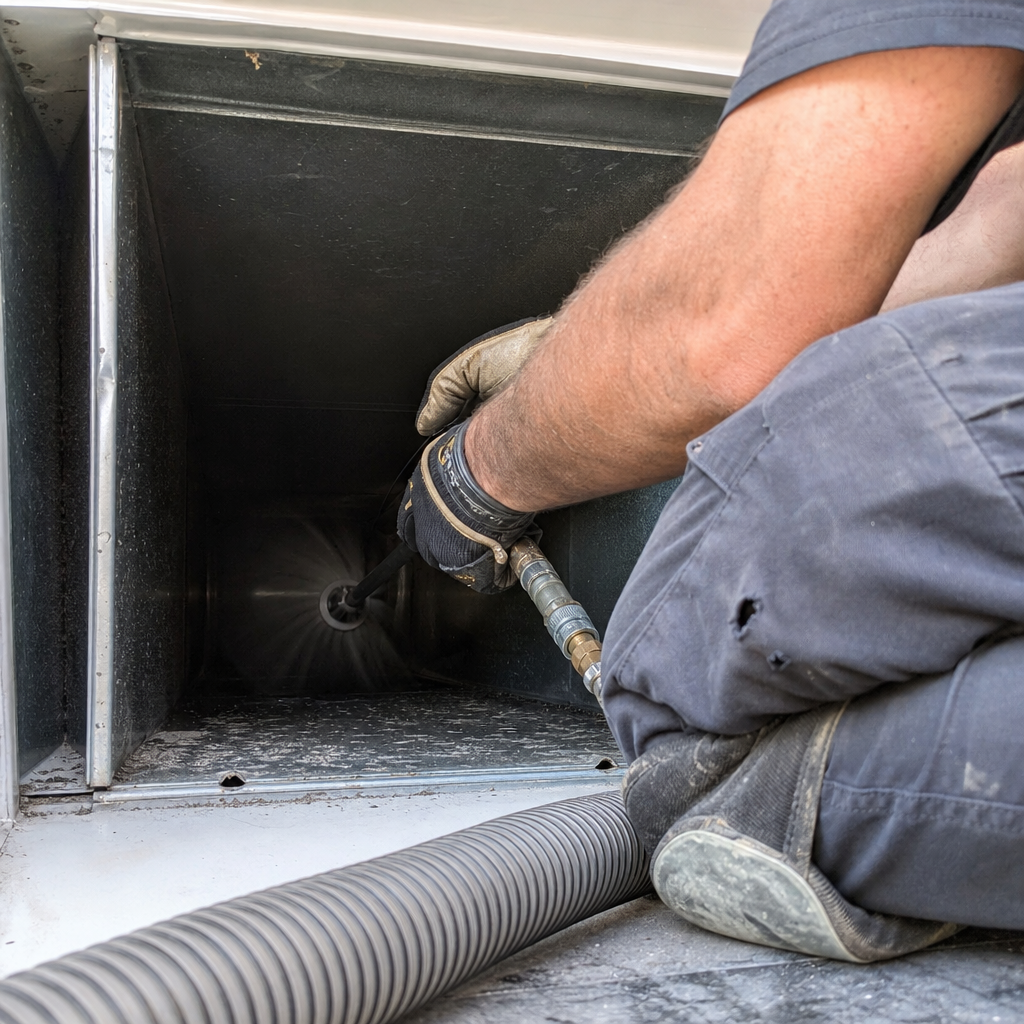
- Interior duct trunk lines. Without a borescope or camera system, you cannot see past the first few feet of main trunk. The Rotobrush contact-cleaning systems we use include camera verification for this reason.
- Static pressure testing. This requires a manometer and knowledge of your system’s design CFM. High static pressure indicates blockage or undersized ductwork—common in Wichita ranch homes with original 1960s systems that were never designed for modern MERV filters.
- Mold or biological growth identification. What looks like “dust” to a homeowner may be fungal growth. Abatement Technologies containment protocols are necessary for safe assessment and remediation.
- Duct sealing and repair. Mastic application, Aeroseal injection, or mechanical repair of galvanized trunk lines requires training and proper PPE.
Logging Baseline Observations: Measure Buildup, Don’t Guess
The most useful thing a homeowner can do is stop guessing and start measuring. We recommend a simple log that transforms vague “it seems dustier” complaints into actionable data.
Create a duct observation log with these entries:
- Filter replacement date and visual description. Note color, thickness of loading, and any unusual odors. “Heavy gray, uniform loading” is normal Wichita dust. “Clumped, dark, musty” suggests moisture intrusion.
- Register dust accumulation rate. Clean a single register completely, then photograph it weekly. Compare photos month-over-month. In our experience, Wichita homes without whole-house filtration show visible register film within 10–14 days during harvest season.
- Supply air temperature differential. Record at the start of each cooling and heating season. Declining differentials predict coil or blockage issues before they fail completely.
- Humidity readings by room. A $15 hygrometer in your main living space reveals duct leakage patterns—rooms with chronically low humidity in winter are often pulling dry attic air through disconnected returns.
- Energy usage correlation. Note if filter changes coincide with utility bill changes. We’ve seen Wichita homeowners reduce summer cooling costs by 8–12% simply by maintaining proper airflow through consistent filter management.
After 12 months of logging, you’ll know your home’s specific buildup rate—not a manufacturer’s generic schedule. That data also gives any technician concrete history rather than symptom descriptions.
Post-Storm Duct Checks: What Wichita Storm Season Does to Your System
Wichita’s position in Tornado Alley means our maintenance checklist must include post-event protocols that don’t appear in coastal or mountain climate guides.
Pressure boundary stress. Even if your home sustained no visible damage, nearby tornadoes or severe straight-line winds create rapid pressure changes. These force unfiltered air through gaps in duct seams, electrical penetrations, and poorly sealed return plenums. After any severe weather warning in your immediate area:
- Run the system on fan-only for 30 minutes before switching to heating or cooling; this purges any debris drawn in during the event.
- Check the filter immediately—storm debris loads filters faster than normal operation.
- Smell test at each register. Musty, earthy, or “attic” odors indicate envelope breach pulling unconditioned air.
- Inspect outdoor condenser for hail damage, debris impaction, or displaced coil fins.
Flooding and moisture intrusion. Wichita’s flash flooding risk—particularly in low-lying areas near the Arkansas River and its tributaries—can affect crawl space or basement ductwork even when living spaces stay dry. If water entered your crawl space:
- Do not run the HVAC until ductwork in the affected zone is inspected. Wet fiberglass duct liner becomes a mold substrate within 48–72 hours in Wichita’s summer humidity.
- Visible water lines on duct exterior indicate interior exposure that requires professional drying and sanitizing.
After the 2019 flood event, we replaced duct systems in several Wichita homes where homeowners had resumed normal operation unaware that standing water had saturated underground flex runs. The Abatement Technologies particulate containment systems we deploy are specifically designed for post-event remediation scenarios.
When a Checklist Item Becomes a Professional Call
Clear thresholds prevent the “maybe I’ll wait” delay that turns a $300 cleaning into a $2,000 repair. Here are the specific lines we tell Wichita homeowners to watch for.
| Observation | Homeowner Action | Professional Threshold |
|---|---|---|
| Filter darker than usual at 30 days | Replace, note in log | Replaces every 2 weeks for 2+ cycles |
| Visible dust on registers | Vacuum boot, monitor | Returns within 7 days after cleaning |
| Single room temperature variation | Check for blocked register | Variation >5°F after register check |
| Musty odor at startup | Run fan-only 30 min, replace filter | Odor persists after filter change |
| Post-storm debris in filter | Replace, run fan-only | Unusual odors or visible moisture in duct |
| Humidity reading below 25% winter | Check for open windows/doors | Multiple rooms, consistent readings |
When you hit the professional threshold, the inspection should include camera verification of interior trunk lines and static pressure measurement. Any quote for duct cleaning that doesn’t include these assessments is incomplete.
Common Mistakes to Avoid
- Buying the highest MERV filter available. MERV 13+ filters load with Wichita agricultural dust so quickly they become airflow restrictions. We’ve restored blower performance in dozens of homes simply by switching homeowners from MERV 13 to MERV 8 with more frequent changes.
- Ignoring the return side. Homeowners clean supply registers because they’re visible. But return air pathways—especially the large return grille near the furnace—pull in the most particulate. That grille should be your most frequent vacuum target.
- Using “duct cleaning” as a DIY project with a shop vacuum. Residential vacuums lack the CFM to create negative pressure in ductwork. Without containment, you’re simply relocating dust to your living space. Professional-grade Nikro negative-pressure systems operate at 5,000+ CFM with HEPA filtration.
- Skipping post-renovation cleaning. Wichita’s active remodeling market means drywall dust, insulation particles, and sawdust enter systems even with “careful” contractors. We recommend professional cleaning after any project involving wall demolition or floor sanding.
- Assuming new construction is clean. New Wichita subdivisions—especially in west Wichita and Maize—often have construction debris in ducts from the builder’s initial HVAC startup. That “new house smell” is often off-gassing from debris baking on the heat exchanger.
- Waiting for “allergy symptoms” as the trigger. By the time occupants notice respiratory effects, the system has been circulating degraded air for months. Use the logging system above for proactive maintenance.
- Hiring based on coupon price alone. The $99 duct cleaning special typically involves a shop vacuum and 45 minutes on site. Proper contact cleaning with Rotobrush agitation and negative-pressure extraction takes 3–5 hours for a typical Wichita ranch home.
When to Call a Professional
Call for professional assessment when you observe: persistent temperature imbalances after register checks, musty or chemical odors that survive filter changes, visible moisture or rust in any duct component, post-storm debris with associated odors, or any accumulation rate that exceeds your logged baseline by more than 50%.
Atlas Air Duct & Vent Cleaning Kansas offers free estimates in Wichita—call (855) 595-7944. Henry Wood, owner and lead technician, will be on your job, not a rotating crew member. With 17 years inside duct systems and professional-grade Rotobrush and Nikro equipment, we assess what your checklist reveals and fix what it can’t reach. From cleaning to repair to sanitizing—handled in one visit.
Frequently Asked Questions
Every 3–5 years for typical residential systems, or sooner if you’ve completed renovations, noticed accelerated dust accumulation, or experienced a major weather event. Homes near active agricultural fields in Wichita’s outlying areas may need more frequent service due to higher particulate loads during harvest season. Call (855) 595-7944 for a free estimate to assess your specific system condition.
No—residential vacuums lack the airflow volume and containment capability to clean duct interiors effectively. Without negative-pressure containment, DIY attempts simply redistribute dust into your living space and may damage flexible ductwork. Professional systems like the Nikro negative-pressure vacuums we use operate at remediation-grade CFM with HEPA filtration.
Wichita’s agricultural harvest seasons—late spring through early summer for wheat, fall for corn and sorghum—generate particulate loads that standard filtration cannot handle at volume. Additionally, spring pollen peaks and winter heating dryness make existing dust more visible and airborne. Your specific neighborhood matters: homes in Maize, Andover, and west Wichita near active fields see heavier seasonal loading than central city properties.
Replace your filter immediately, run the system on fan-only for 30 minutes before heating or cooling, and smell-test each register for musty or attic odors. Even without visible home damage, pressure boundary stress from nearby severe weather can draw unfiltered air into duct systems. Persistent odors or moisture indicators require professional camera inspection.
Filters protect equipment; they don’t clean duct interiors. Over years, accumulation on duct surfaces becomes a reservoir that reintroduces particulate even with new filters. In our 17 years of work, we’ve found that homes with regular professional cleaning maintain more consistent airflow, more even temperatures, and lower utility costs. The 276 customers who reviewed us at 4.8 stars consistently note improved system performance post-cleaning.
Legitimate quotes specify the equipment (Rotobrush contact-cleaning, negative-pressure extraction), include camera verification of results, and estimate realistic timeframes (3–5 hours for typical homes). Beware of $99 specials that don’t specify methodology or duration. At Atlas, Henry Wood provides upfront pricing with no arrival upsells—what we quote is what you pay.
The Bottom Line
Wichita’s unique combination of agricultural particulate, humidity cycling, and storm exposure demands a maintenance approach more specific than national guidelines provide. The homeowners who maintain best results combine disciplined self-inspection—monthly filter checks, quarterly register cleaning, and systematic logging—with periodic professional service using equipment that actually removes accumulated debris rather than redistributing it. Your duct system is not a sealed environment; it’s a dynamic pathway that reflects everything in your home’s air. Treat it with the specificity Wichita’s conditions require, and it will return that care with consistent performance and cleaner indoor air.
Written by Henry Wood, Owner & Lead Technician at Atlas Air Duct & Vent Cleaning Kansas, serving Wichita since 2009.