
Last updated July 11, 2026
How to Hire a Air Duct Cleaning Contractor in Wichita: A Step-by-Step Guide
Here’s what most Wichita homeowners learn too late: the worst duct cleaning jobs don’t look bad on the surface. The vents get vacuumed, the crew leaves, and six months later you’re wondering why your energy bills climbed and your allergies flared worse than before. In our 17 years inside Wichita duct systems, we’ve opened up “recently cleaned” plenums in Riverside, College Hill, and Delano neighborhoods only to find collapsed flex duct, blown insulation scattered through trunk lines, and access panels left unsealed. The three questions most homeowners never ask a contractor are the exact three questions that would have saved them — and none of them are about price. This guide gives you a verbatim interview script, explains what credentials actually matter in Kansas, and shows you how to read a quote structure like a technician would.
Quick Answer
Hiring a qualified air duct cleaning contractor in Wichita means verifying Kansas business registration, confirming NADCA certification or equivalent training, and requiring line-item pricing that separates vent count from trunk line and plenum work. Ask five diagnostic questions before scheduling — poor answers on equipment type, containment method, or access point strategy are immediate disqualifiers. Expect to pay $400–$900 for a complete residential system in the Wichita market, with whole-house quotes under $300 signaling a blow-and-go operation that can damage your HVAC system.
Table of Contents
- The Three Questions That Disqualify Bad Contractors
- Five Diagnostic Questions to Ask Before Scheduling
- NADCA, Kansas Licensure, and What Credentials Actually Verify
- How to Read a Quote Structure: Per-Vent vs. Whole-System Pricing
- Owner-Operated vs. Franchise: Why It Matters for Duct Work
- Before-and-After Documentation: Setting Expectations in Writing
- Wichita-Specific Considerations: Climate, Codes, and Common Issues
- Common Mistakes to Avoid
- When to Call a Professional
- Frequently Asked Questions
The Three Questions That Disqualify Bad Contractors
Most Wichita homeowners ask about price, availability, and whether the company is “licensed and insured.” Those are fine starting points, but they won’t protect you from the crews who cause real damage. The three questions that actually matter:
Question 1: “What equipment physically contacts the duct walls?”
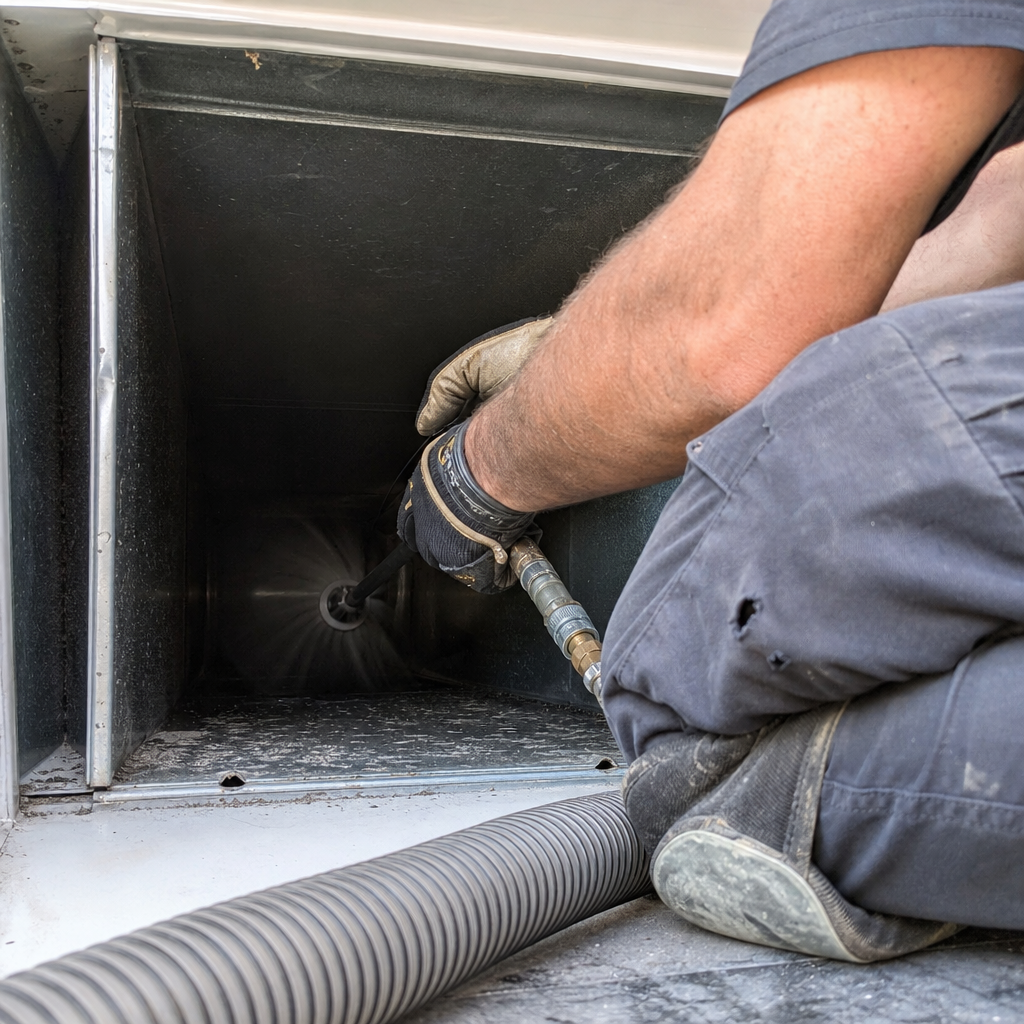
A legitimate duct cleaning contractor uses contact-cleaning equipment — Rotobrush systems with spinning brush heads, or pneumatic whips and skipper balls driven by compressed air. If the answer is “a high-powered vacuum” or “a truck-mounted suction system” with no mention of agitation, you’re paying someone to vacuum the vent covers and maybe the first three feet of each run. The remaining 80% of your ductwork stays untouched. We’ve inspected systems in West Wichita where homeowners paid $199 for “complete cleaning” and found packed dust layers still adhered to the trunk line walls.
Question 2: “How do you contain dislodged debris during cleaning?”
Negative pressure is non-negotiable. Professional-grade Nikro negative-pressure vacuums create suction at the point of disturbance, pulling debris toward the collection point rather than letting it escape into your living space. If a contractor describes “sealing rooms” or “using HEPA filters on our shop vac” as their containment strategy, they don’t understand negative-pressure methodology. In older Wichita homes near the Arkansas River with original galvanized ductwork, poor containment can redistribute decades of accumulated particulate through every room.
Question 3: “Where will you cut access panels, and how will you seal them afterward?”
This question separates technicians from laborers. Proper duct cleaning requires strategic access points — typically in the plenum or main trunk line — to insert agitation tools and vacuum hoses. A contractor who says “we don’t need to cut access” is either lying or not cleaning the full system. One who can’t describe their sealing method (sheet metal patches with mastic, or proper access doors for future service) is creating air leaks that cost you more in energy loss than the cleaning cost.
Five Diagnostic Questions to Ask Before Scheduling
Use this verbatim script when you call. Write down the answers. Any single red-flag response is grounds for hanging up and calling the next contractor.
- “Walk me through your cleaning sequence from the moment you arrive.”
Listen for: system inspection before activation, register removal and hand-cleaning, negative-pressure vacuum connection at the plenum, contact agitation of each supply and return run, trunk line cleaning, plenum cleaning, register reinstallation, and system test. Red flag: “We hook up the vacuum and blow air through the vents” — this describes a 45-minute job, not a cleaning.
- “What brand and type of agitation equipment do you use?”
Listen for: specific brand names (Rotobrush, Nikro, Abatement Technologies) and descriptions of contact-cleaning heads or pneumatic tools. Red flag: “We have a really powerful truck-mounted system” — suction without agitation is not duct cleaning, it’s vent vacuuming.
- “How do you handle flex duct or duct board in my system?”
Listen for: adjusted pressure settings, softer brush heads, or bypass strategies for fragile materials. Red flag: “We use the same process on everything” — aggressive agitation in flex duct tears the inner liner and creates leaks that are expensive to repair.
- “Will the same technician who estimates my job perform the work?”
Listen for: yes, with specific naming, or a clear explanation of technician assignment. Red flag: “We have a crew” or “It depends on scheduling” — this signals a franchise model where the estimator sells and unknown laborers execute. In Wichita’s owner-operated shops like ours, Henry Wood, owner and lead technician, will be on your job from estimate through completion.
- “What documentation do you provide showing before-and-after condition?”
Listen for: photo or video documentation, with specific mention of what gets captured (interior duct walls, plenum condition, filter status). Red flag: “We can show you the debris we collected” — volume of debris proves nothing about whether the ducts are actually clean. Visual documentation of the interior surfaces is what matters.
NADCA, Kansas Licensure, and What Credentials Actually Verify
NADCA — the National Air Duct Cleaners Association — is the closest thing to an industry standard, but its membership structure creates confusion worth understanding.
What NADCA membership verifies: The company has paid dues, signed a code of ethics, and at least one employee has passed the ASCS (Air Systems Cleaning Specialist) exam. The ASCS exam covers assessment protocols, cleaning standards (NADCA ACR), and HVAC system fundamentals. It’s a legitimate knowledge barrier.
What NADCA membership does NOT verify: That the person who shows up at your Wichita home holds the ASCS credential, or that the company follows NADCA standards on every job. We’ve encountered NADCA-member companies in the Wichita market who dispatch crews with no certified technician present. The membership certificate hangs in the office; the actual work gets done by hourly labor.
Kansas licensure is a separate, essential check. Kansas does not license duct cleaning as a standalone trade, but any contractor performing HVAC modification (which includes cutting access panels into plenums) must hold a Kansas HVAC contractor license or work under a licensed master. Verify through the Kansas Department of Labor’s license lookup — or ask for the license number and check yourself. A contractor who hesitates to provide this is operating outside regulatory boundaries.
Insurance verification without specific numbers: Request a certificate of insurance naming you as additional insured for the date of service. Don’t accept “we’re fully insured” as a verbal claim. The certificate comes from the insurance broker, not the contractor’s printer.
How to Read a Quote Structure: Per-Vent vs. Whole-System Pricing
Quote structure reveals methodology. Here’s how to interpret what you’re being offered in the Wichita market:
| Pricing Model | Typical Range (Wichita) | What It Signals |
|---|---|---|
| Per vent/register (supply + return counted separately) | $25–$45 per opening | Transactional, often minimum-charge driven; may exclude trunk lines and plenum |
| Whole-system flat rate (vent count ranges) | $400–$700 (up to 12 vents) | Comprehensive scope; verify trunk line and plenum are explicitly included |
| Whole-system flat rate with line-item adders | $500–$900+ | Most transparent; separates base cleaning from sanitizing, access panel installation, or duct repair |
| Whole-house “special” under $300 | $89–$299 | Blow-and-go operation; high probability of upsell pressure or incomplete work |
The per-vent model isn’t inherently dishonest, but it incentivizes speed. A crew paid per vent moves fast and may skip the trunk line entirely — the largest surface area in your system. The whole-system model with explicit inclusions is preferable for Wichita’s older homes, where trunk lines in basements and crawl spaces often hold the heaviest accumulation.
Line-item adders deserve attention. Sanitizing with EPA-registered products, access panel installation for future service, or duct sealing with mastic are legitimate additional services that should be separately priced, not bundled into vague “premium packages.” At Atlas Air Duct & Vent Cleaning Kansas, we itemize every component so you know exactly what each phase costs before we start.
Owner-Operated vs. Franchise: Why It Matters for Duct Work
The duct cleaning industry runs on two models, and the difference affects your home directly.
Franchise/volume model: National brand sells territories. Local owner hires technicians, often with high turnover. Equipment is leased or financed. The person who estimates your job is incentivized to sell; the crew who arrives may have cleaned ducts for three weeks. We’ve been called to correct jobs in Eastborough and Crown Heights where franchise crews disconnected flex duct in attics, left access holes unsealed, or damaged evaporator coils with careless hose handling.
Owner-operated model: Henry Wood, owner and lead technician, will be on your job. The same person who assesses your system performs the work, owns the equipment, and answers for the result. Equipment maintenance is personal — our Rotobrush and Nikro systems are serviced on schedule because downtime costs us directly, not some corporate equipment pool. Accountability is immediate; there’s no district manager to escalate to, because the owner is the technician standing in your utility room.
In Wichita specifically, owner-operated shops tend to serve tighter geographic areas, which means faster response for follow-up if issues arise. We’ve returned to homes in Riverside three years after initial cleaning to address new concerns — try getting that continuity from a franchise rotating its third crew in two years.
Before-and-After Documentation: Setting Expectations in Writing
Verbal promises about “you’ll see the difference” are worthless. Insist on written documentation standards before scheduling:
- Photo documentation: Interior duct surfaces at multiple points — supply trunk, return trunk, and at least two branch runs — captured before and after cleaning. Timestamped if possible.
- Video documentation: Walk-through footage showing agitation tool insertion and debris removal in progress. This proves methodology, not just result.
- Written scope: Specific count of supply vents, return vents, trunk lines, and plenum sections included. Any exclusions noted explicitly.
- System test record: Static pressure readings before and after, if the contractor has the equipment. Pressure drop reduction is objective proof of improved airflow.
We provide photo documentation as standard on every Wichita job, with images delivered electronically within 24 hours. If a contractor treats documentation as an upsell or “premium service,” they’re not confident in their work product.
Wichita-Specific Considerations: Climate, Codes, and Common Issues
Wichita’s climate and housing stock create distinct duct cleaning challenges that generic guides miss.
Wind-blown particulate: Our position on the Great Plains means sustained winds carry agricultural dust, pollen, and fine particulate through intake vents. Homes in western Wichita near open fields see heavier return duct loading than eastern neighborhoods with more tree buffer. A proper cleaning account for this by extending return trunk cleaning time.
Humidity cycling: Kansas summers push 90°F+ with humidity spikes; winters drop below freezing. This expansion-contraction cycle loosens dust adhesion in metal ducts but can degrade flex duct adhesive over time. Technicians must adjust agitation intensity based on duct material age — we’ve found original flex duct in 1980s Wichita homes near Towne East that tears under standard brush pressure.
Basement and crawl space access: Wichita’s older neighborhoods — College Hill, Riverside, Delano — feature varied foundation types. Some trunk lines run through dirt-floored crawl spaces with limited access. A contractor who quotes without inspecting access constraints is guessing at scope. We routinely encounter jobs where the initial phone estimate changes after physical access assessment, and we communicate that openly rather than surprise-billing on arrival.
Local code awareness: Wichita follows the Kansas Uniform Building Code with amendments. Duct modifications, including access panel installation, must maintain fire ratings where ducts pass through rated assemblies. A contractor unfamiliar with local amendment specifics can create code violations that complicate future home sales.
Common Mistakes to Avoid
- Booking based on coupon price alone. The $99 whole-house special in Wichita inevitably becomes $600+ on arrival, or leaves your system damaged. Real equipment, real time, and real expertise have floor costs.
- Assuming NADCA membership guarantees technician competence. Verify who holds the ASCS credential and whether they’ll be present during your job.
- Neglecting to ask about containment methodology. In Wichita’s tight, energy-efficient newer homes, poor containment redistributes debris through the entire living space.
- Accepting verbal scope without written confirmation. “Complete cleaning” means nothing specific. Vent count, trunk line inclusion, and plenum access must be documented.
- Ignoring flex duct condition before agitation. Original flex duct in Wichita’s 1970s–1990s housing stock can be degraded; aggressive cleaning destroys it.
- Failing to verify follow-up access. If issues arise, can you reach the same technician? Owner-operated shops provide continuity that franchise dispatch models don’t.
When to Call a Professional
Call a qualified contractor when you notice uneven airflow between rooms, visible dust emission from registers, musty odors that persist after filter changes, or allergy symptoms that worsen when your HVAC runs. After any renovation — especially drywall work or flooring replacement — duct inspection is prudent; construction dust infiltrates return systems and settles in trunk lines where standard filters can’t reach.
In Wichita’s spring pollen season and fall harvest dust periods, demand peaks and lead times extend. Scheduling preventive cleaning in off-peak months often secures better appointment availability and more thorough attention.
Atlas Air Duct & Vent Cleaning Kansas offers free estimates in Wichita — call (855) 595-7944. Henry Wood, owner and lead technician, will assess your system personally and provide written scope and documentation standards before any work begins.
Frequently Asked Questions
Complete residential air duct cleaning in Wichita typically ranges from $400 to $900 depending on system size, duct material, and accessibility. Whole-house quotes below $300 usually indicate incomplete scope or upsell-dependent pricing. Call (855) 595-7944 for a free, itemized estimate based on your specific vent count and layout.
Every 3–5 years for typical residential systems, with shorter intervals if you have pets, recent renovation, or occupants with respiratory sensitivities. Wichita’s wind-blown particulate and seasonal pollen loads justify the shorter end of that range for homes near open fields or with mature landscaping.
Duct cleaning addresses the distribution network — supply and return runs, trunk lines, and plenum. HVAC cleaning includes the air handler components: evaporator coil, blower assembly, and cabinet interior. A complete indoor air quality service addresses both; cleaning ducts alone while leaving a contaminated coil recirculates debris immediately. HVAC Cleaning in Kansas City covers the full mechanical scope.
Yes, if performed improperly. Aggressive agitation in degraded flex duct tears the liner. Improper access panel sealing creates air leaks. Uncontained debris can foul electronic components. This is why equipment type, technician training, and documentation standards matter more than price.
A thorough residential cleaning of a typical Wichita home — 8–12 vents, accessible basement or crawl space — requires 3–5 hours. Jobs completed in under 90 minutes almost certainly skipped trunk lines, plenum, or proper register cleaning. Time on site correlates directly with scope completion.
If your dryer vent hasn’t been cleaned in 12 months, yes. Lint accumulation in dryer vents is a leading cause of residential fires, and the same access and equipment mobilization makes combined service efficient. Dryer Vent Cleaning in Kansas City details our process for exhaust duct evaluation and cleaning.
The Bottom Line
Hiring a duct cleaning contractor in Wichita is an exercise in disqualification. The good companies answer diagnostic questions with specific equipment names, documented methodologies, and clear scope. The risky ones offer vague assurances and pressure you toward quick booking. Use the five-question script, verify Kansas HVAC licensure for any access panel work, demand written documentation standards, and weight quote structure as heavily as total price. The cheapest quote often costs the most in energy loss, system damage, and repeat service. For homeowners who want the most experienced person in the company doing the actual work, owner-operated shops provide accountability that franchise volume models cannot replicate.
Written by Henry Wood, Owner & Lead Technician at Atlas Air Duct & Vent Cleaning Kansas, serving Wichita since 2009.