
Last updated July 11, 2026
Seasonal Air Duct Cleaning Care for Wichita: Year-Round Homeowner’s Guide
Here’s what most Wichita homeowners get wrong about air duct cleaning: spring is the worst time to do it. When the Kansas green-up hits and elm, cottonwood, and grass pollen counts spike past 8,000 grains per cubic meter, you’re essentially paying to clean a system that will be re-contaminated within 72 hours. After 17 years inside duct systems across Wichita, from Riverside bungalows to new builds in Andover, we’ve learned that timing your duct care to the city’s actual contamination cycles—not the calendar—saves money and delivers lasting results. This guide breaks down what enters your ducts each season in Wichita, when to schedule work, and how to maintain your system so you’re preventing problems instead of chasing them.
Quick Answer
The optimal duct cleaning schedule for Wichita runs late fall through early winter, with secondary maintenance windows in late summer. Spring’s pollen surge and early fall’s harvest dust make those seasons poor choices for deep cleaning. Year-round care means adjusting filter changes, humidity control, and inspection timing to match what the Kansas climate is actually putting into your system.
Table of Contents
- Why Seasonal Timing Matters in Wichita
- Spring: The Season to Inspect, Not Clean
- Summer: Humidity, Mold Pressure, and Flex Duct Stress
- Fall: Harvest Dust and the Optimal Cleaning Window
- Winter: Dry Air, Static, and Post-Heating Inspection
- Your Wichita Seasonal Maintenance Calendar
- Choosing Filters and Equipment for Kansas Conditions
- Common Mistakes to Avoid
- When to Call a Professional
- Frequently Asked Questions
- The Bottom Line
Why Seasonal Timing Matters in Wichita
Wichita sits at the convergence of three distinct air mass patterns: Gulf moisture from the south, dry western plains air, and agricultural particulate from the surrounding wheat and sorghum belt. That combination creates contamination profiles you won’t find in coastal or mountain climates. What enters your return grilles in April is chemically and physically different from what accumulates in October, and treating both the same way wastes money.
We’ve pulled samples from duct systems across the metro—Delano, College Hill, Bel Aire, Haysville—and the seasonal variation is stark. Spring deposits are protein-heavy pollen grains that swell with humidity and adhere to duct walls. Summer brings mold spores and skin cells amplified by air conditioning runtime. Fall loads are silica-rich harvest dust that abrades flex duct interiors. Winter accumulation is fine carbon and clay particulate from combustion and wind erosion.
Each type responds differently to cleaning methods. Pollen swells and clogs when wet-cleaned. Harvest dust requires negative-pressure extraction rather than contact brushing alone. Mold needs source removal plus antimicrobial treatment, not just vacuuming. This is why Atlas Air Duct & Vent Cleaning Kansas adjusts our Rotobrush and Nikro equipment protocols seasonally—one approach doesn’t fit all.
The financial case is straightforward. A duct cleaning done at the wrong time in Wichita typically shows visible re-contamination within 6–8 weeks. Done in the optimal window, with proper seasonal maintenance following, we’ve tracked 18–24 months of stable system performance before the next deep cleaning is warranted.
Spring: The Season to Inspect, Not Clean
March through May in Wichita brings the highest pollen counts in the central United States. The city’s dense elm canopy, established neighborhoods with mature cottonwoods, and surrounding grasslands release particulate that overwhelms standard filtration. Here’s what we find when we scope ducts in April: fresh pollen grains packed 2–3mm deep on return duct floors, already germinating in the humid microclimate behind supply registers.
Cleaning this load out in peak season is futile. We’ve had customers in Crown Heights and Sleepy Hollow call us back within a month of spring cleanings, confused why dust is already visible. The answer: it isn’t dust. It’s new pollen, and it will keep coming until the green-up finishes in late May.
What to do instead in spring:
- Inspect your system’s intake points. Check that outdoor air dampers are sealing properly—many Wichita homes built 1995–2010 have degraded gaskets that pull unfiltered pollen directly into the return.
- Upgrade to MERV 11–13 pleated filters. Standard fiberglass panels pass 80% of pollen grains. We specify Aprilaire 213 or 413 media for Wichita spring conditions—these capture particles down to 1 micron without overloading residential blowers.
- Seal visible duct leaks at returns. A 1/4″ gap in a return plenum in a 1970s ranch in West Wichita can pull 15–20% of system air from the attic or crawlspace, bypassing filtration entirely.
- Schedule your deep cleaning for late May or early June. After the pollen peak drops below 1,000 grains/m³, cleaning captures the accumulated load before summer humidity sets in.
Spring is for preparation and protection. Save the aggressive extraction for when the air outside isn’t actively fighting you.
Summer: Humidity, Mold Pressure, and Flex Duct Stress
Wichita’s July and August dew points regularly hit 70°F, and that moisture doesn’t stay outside. When your air conditioning runs 14–16 hours daily, the temperature differential between conditioned air (55°F at the coil) and attic air (140°F+) creates condensation points throughout the duct system. This is where we see the most expensive hidden damage.
Flex duct—common in Wichita homes built 1985–2005—has a particular vulnerability. The fiberglass insulation core absorbs moisture at sag points and low spots. Over three to five summers, that insulation compacts, reducing R-value and creating permanent cold spots where mold colonizes. We’ve opened flex runs in Derby and Park City that looked clean externally but harbored Cladosporium and Penicillium colonies across 40% of the interior surface.
Summer inspection checklist for Wichita homeowners:
- Check flex duct for sagging greater than 1/2 inch per foot of run—water pools at the low point
- Inspect insulation vapor barrier for tears, especially at connection boots
- Run your system for 30 minutes, then feel supply registers for temperature consistency—cold spots indicate blockages or moisture damage
- Monitor indoor humidity with a calibrated hygrometer; sustained readings above 58% signal duct leakage or oversized equipment
- Look for dark staining on ceiling drywall around supply boots in second-story rooms—often the first visible sign of duct condensation
If you’re considering summer cleaning, timing matters. Early June, before the worst humidity arrives, allows us to clean and seal with adequate drying time. Mid-August, when the cooling load peaks, is when we prefer to do full system assessments—equipment is stressed, and problems are visible. But avoid July deep cleanings unless there’s active mold remediation needed; the ambient humidity makes proper drying and antimicrobial application difficult to verify.
For homes with chronic summer moisture issues, we deploy Abatement Technologies HEPA containment and drying equipment during cleaning—restoration-grade capability that standard residential duct cleaners don’t carry. This prevents cross-contamination and ensures the system is genuinely dry before we seal it back up.
Fall: Harvest Dust and the Optimal Cleaning Window
September through mid-November is Wichita’s best season for comprehensive duct cleaning. Here’s why: the pollen cycle has ended, humidity is dropping, harvest dust hasn’t peaked yet, and your system is about to transition from cooling to heating—meaning any accumulated debris will be baked onto heat exchangers and recirculated all winter if not removed now.
The harvest factor is specific to this region. When wheat, sorghum, and corn come off fields across Sedgwick and surrounding counties, the particulate load shifts dramatically. Harvest dust is silica and cellulose-dominant, with sharp edges that abrade duct interiors and don’t respond well to wet methods. We’ve measured post-harvest particulate counts in rural-leaning Wichita exurbs at 3–4x urban levels.
Why late October to mid-November is ideal:
- Harvest dust has largely settled, but hasn’t been pulled into heating systems yet
- Cooler temperatures mean your HVAC runtime is minimal—we can clean without disrupting comfort
- Low ambient humidity ensures proper drying of any antimicrobial treatments
- Pre-heating-season timing means clean ducts for the months when you’re most closed up indoors
- Flexible scheduling—this is our slower season, so we can book thorough, unhurried work
In our experience across Wichita neighborhoods from Midtown to Kechi, fall cleanings show the longest time-to-recontamination. Customers who maintain with proper filter changes after a November cleaning typically don’t need deep service again for 20–24 months. That’s the value of working with the contamination cycle instead of against it.
This is also the season to assess whether your duct system needs repair or sealing before heating load hits. Air Duct Cleaning in Kansas City and Wichita share similar fall profiles, and our approach accounts for the regional harvest dust pattern that national franchises often miss.
Winter: Dry Air, Static, and Post-Heating Inspection
Wichita winters are drier than most homeowners realize. January relative humidity indoors often drops to 25–30%, and that dryness changes what’s happening in your ducts. Static electricity builds on plastic flex duct interiors, causing fine particulate to cling in patterns we call “dust veining”—visible lines following air turbulence patterns that standard vacuuming won’t fully remove.
More critically, heating season reveals problems hidden during cooling. When gas furnaces cycle on, the rapid temperature rise in supply plenums can crack decades of dust accumulation, sending particulate pulses through registers. We’ve had calls from homeowners in Eastborough and Rockhurst who noticed “dust storms” from supply vents on cold January mornings—this is why.
Winter maintenance priorities:
- Inspect the return plenum and filter rack after 60 days of heating runtime—this is where dust cake is thickest
- Check heat exchanger visual access points for soot or rust streaking, which indicate combustion byproducts entering airflow
- Monitor for static shocks at registers—sign of excessively dry air and potential duct leakage pulling attic air
- Listen for blower motor strain; heating season dust load can push marginal motors into failure
- Schedule any needed repairs before February cold snaps, when HVAC contractors are overwhelmed and duct specialists have availability
Winter is not a cleaning season unless there’s a specific problem—post-renovation debris, vermin intrusion, or visible mold from summer moisture. But it is a critical inspection window. What you find in January informs what you schedule for the following fall. We’ve built our HVAC Cleaning in Kansas City and Wichita winter protocols around this diagnostic approach.
Your Wichita Seasonal Maintenance Calendar
Based on 17 years tracking Wichita’s contamination cycles, here’s the schedule we recommend to our customers. Adjust based on your home’s age, filtration, and whether you have pets or recent renovation history.
| Season | Primary Action | Filter Type/Change | Professional Service |
|---|---|---|---|
| Spring (Mar–May) | Inspect, seal leaks, upgrade filtration | MERV 11–13 pleated, change every 30–45 days | System assessment only if problems visible |
| Early Summer (Jun) | Deep clean if missed fall window | MERV 11 pleated, change every 60 days | Cleaning with antimicrobial if moisture history |
| Peak Summer (Jul–Aug) | Monitor humidity, inspect flex duct | MERV 11 pleated, change every 60 days | Mold assessment if humidity sustained >58% |
| Fall (Oct–Nov) | Deep clean, repair, seal before heating | New MERV 11 filter at cleaning, then every 60 days | Comprehensive cleaning—optimal timing |
| Winter (Dec–Feb) | Inspect post-heating startup, monitor static | MERV 11 pleated, change every 60–90 days | Diagnostic inspection, repair scheduling |
Homes in newer Wichita developments with tighter construction (Bel Aire, northeast Andover) can extend intervals by 30%. Pre-1980 homes with original ductwork, or any home with finished basements and extended return runs, should shorten intervals by 30%.
Choosing Filters and Equipment for Kansas Conditions
Filter selection in Wichita requires matching media to season, not just buying the highest MERV rating available. We’ve seen homeowners in Riverside install MERV 16 filters and wonder why their blower failed—too much restriction for residential equipment.
Our Wichita-specific recommendations:
- Spring (pollen peak): Aprilaire 213 (MERV 13) or 413 (MERV 13 with carbon) in compatible cabinet. The electrostatic layer captures sub-micron pollen fragments that pass standard pleats.
- Summer: Aprilaire 210 (MERV 11) standard pleat. Reduced restriction for high-runtime cooling, adequate for mold spore capture.
- Fall: Return to 213/413 for harvest dust, or install fresh 210 at cleaning appointment.
- Winter: 210 or equivalent, changed mid-season. Dry air means less biological growth; focus on particulate capacity.
For whole-house humidity control—critical in Wichita’s swing climate—we specify Aprilaire steam or fan-powered humidifiers integrated to the duct system, not portable units that breed bacteria. In summer, dehumidification through proper duct sealing and right-sized equipment outperforms standalone units.
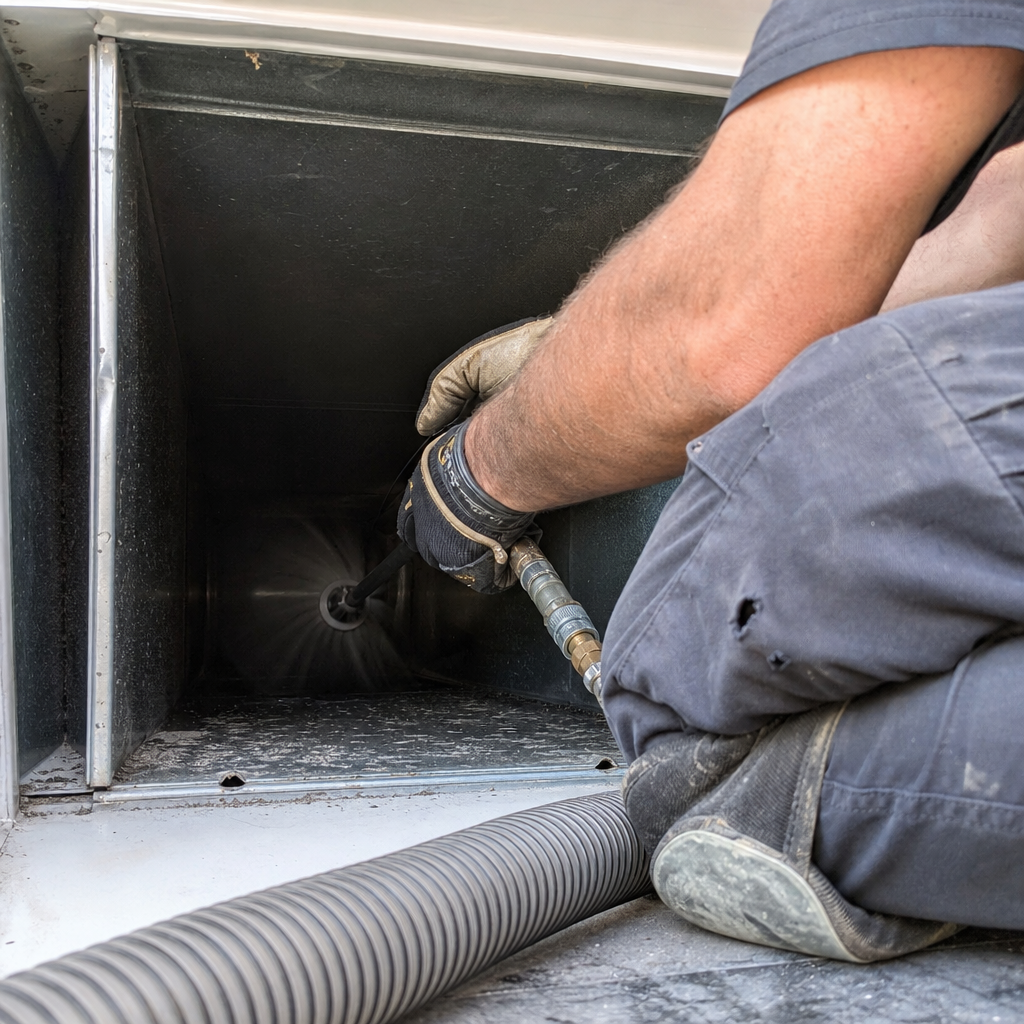
When we clean with our Rotobrush contact-cleaning systems, we match brush aggressiveness to duct material and season. Post-harvest silica loads need stiffer bristles and higher vacuum pull from our Nikro negative-pressure units. Spring pollen requires gentler contact to avoid grinding grains into duct pores. This isn’t equipment marketing—it’s the difference between cleaning that lasts and cleaning that looks good for a week.
Our Guardsman antimicrobial treatments, applied where moisture history indicates risk, are EPA-registered for HVAC use and applied with controlled droplet size to avoid over-wetting. We don’t fog or “bomb” ducts—those methods leave residue that attracts future contamination.
Common Mistakes to Avoid
- Scheduling spring cleaning during pollen peak. We’ve covered this, but it bears repeating: April appointments in Wichita are reactive marketing, not sound maintenance. You’re paying to clean what will return immediately.
- Ignoring flex duct condition. Wichita’s humidity cycles destroy flex duct from the inside. Exterior appearance means nothing. We replace 15–20% of flex runs we inspect in homes over 20 years old.
- Using the wrong filter season-round. A MERV 8 fiberglass panel in April passes most pollen. A MERV 16 in July overloads your blower. Match the media to the threat.
- Cleaning without inspecting the dryer vent. Dryer Vent Cleaning in Kansas City and Wichita are related services—lint accumulation stresses the same exhaust infrastructure and creates fire risk. We bundle assessment because the problems connect.
- Assuming “no dust” means clean ducts. Fine particulate and biological growth aren’t always visible at registers. If your energy bills are climbing or rooms have uneven temperatures, the ducts need scoping regardless of visible dust.
- Waiting for symptoms. By the time Wichita homeowners notice allergy flares or musty odors, contamination is established. Preventive scheduling based on the calendar above avoids reactive emergency service.
When to Call a Professional
Some duct conditions require equipment and training beyond homeowner capability. Call for professional assessment if you notice: visible mold growth inside registers or duct access panels; persistent musty odor when HVAC cycles on; insect or rodent debris in or near ductwork; post-renovation dust that doesn’t clear with normal cleaning; rooms that are consistently 5°F or more different from thermostat setting; or energy bills that spike without rate changes.
Henry Wood, owner and lead technician, will be on your job—not a dispatched crew member learning the trade. With 17 years inside duct systems and professional-grade Rotobrush and Nikro equipment, we diagnose what coupon cleaners miss. From cleaning to repair to sanitizing—handled in one visit, without scheduling a second company.
Atlas Air Duct & Vent Cleaning Kansas offers free estimates in Wichita. Call (855) 595-7944 to schedule a seasonal assessment or fall cleaning window.
Frequently Asked Questions
Whole-system duct cleaning for a typical Wichita home runs $400–$700 for single-zone systems, and $800–$1,400 for larger homes with multiple zones or extensive flex duct replacement needs. Factors that move the price: system accessibility, contamination severity, and whether repair or sealing is needed. Call (855) 595-7944 for an exact quote—estimates are free.
Yes, late March through May is the least effective window. Wichita’s pollen counts during green-up are among the highest in the nation, and a freshly cleaned system will pull that load in immediately. We recommend inspecting and upgrading filtration in spring, then scheduling deep cleaning for late fall.
With proper seasonal maintenance and filter changes, most Wichita homes need deep cleaning every 18–24 months. Homes with pets, recent renovation, or pre-1990 ductwork may need annual service. The 276 customers who’ve reviewed us at 4.8 stars include many on customized maintenance schedules based on their specific conditions.
Yes—restricted airflow from duct contamination or leakage forces your blower to work harder and your equipment to run longer. We’ve measured 15–25% efficiency recovery after cleaning and sealing in Wichita homes with neglected systems. The savings often cover the service cost within two heating or cooling seasons.
Duct cleaning addresses the distribution network—supply and return trunks, branches, and registers. HVAC cleaning includes the air handler, coil, blower, and heat exchanger. We offer both because contamination doesn’t respect those boundaries. A clean duct system connected to a fouled coil recirculates problems immediately.
No. Our Nikro negative-pressure systems and Abatement Technologies HEPA containment keep particulate contained during work. Most Wichita homeowners stay and work from home. The process takes 3–5 hours for a typical single-system home, with minimal noise disruption beyond normal vacuum levels.
The Bottom Line
Wichita’s four-season climate demands a four-season approach to duct care. Spring protects against pollen with filtration, not cleaning. Summer manages humidity and mold pressure. Fall delivers the optimal deep-cleaning window before heating season locks you indoors. Winter inspects and diagnoses for the year ahead. Treating duct maintenance as a single annual event—especially one timed to marketing calendars rather than local conditions—means you’re always reacting to the last problem instead of preventing the next one.
After 17 years specializing exclusively in duct and vent systems across this city, we’ve learned that the homeowners who follow seasonal timing save money, breathe easier, and replace equipment less often. The science of what’s in your ducts changes with the Kansas weather. Your maintenance should too.
Written by Henry Wood, Owner & Lead Technician at Atlas Air Duct & Vent Cleaning Kansas, serving Wichita since 2009.