
Last updated July 11, 2026
Air Duct Cleaning Permits, Codes & Inspections in KS: What You Need to Know
Here’s what surprises most Wichita homeowners we’ve worked with over 17 years: Kansas treats standard air duct cleaning as an unregulated maintenance service, but the moment your technician touches a seam sealant, replaces a flex duct section, or sprays an antimicrobial treatment, you’ve crossed into territory that Sedgwick County and the Kansas Department of Health and Environment absolutely regulate. We’ve arrived at jobs in Riverside and College Hill where the previous “cleaning” left homeowners with exposed fiberglass, unpermitted duct modifications, and no recourse because the work was never properly scoped on paper. This guide explains exactly where Kansas draws the line between routine maintenance and regulated work, what Wichita and Sedgwick County require, and how to protect yourself when a cleaning job expands mid-project.
Quick Answer
Standard air duct cleaning in Kansas does not require a permit because it’s classified as maintenance, not construction. However, duct modification, replacement, mold remediation, or any treatment that alters the HVAC system’s performance or air quality classification triggers Kansas mechanical code requirements and may require permitting through your local jurisdiction. In Wichita and Sedgwick County, any work beyond contact cleaning and debris removal should be documented with clear scope boundaries to avoid unpermitted work liability.
Table of Contents
- Cleaning vs. Construction: Where Kansas Draws the Line
- What Wichita and Sedgwick County Actually Require
- When Mold Remediation Changes Everything
- The Credential Gap in Duct Sealing and Antimicrobial Upsells
- How to Protect Yourself Contractually
- Inspection Red Flags We See in Wichita Homes
- Common Mistakes to Avoid
- When to Call a Professional
- Frequently Asked Questions
- The Bottom Line
Cleaning vs. Construction: Where Kansas Draws the Line
Kansas adopts the International Mechanical Code (IMC) with state amendments, and that framework distinguishes sharply between maintenance and alteration. Understanding this distinction saves Wichita homeowners from both regulatory headaches and substandard work.
Standard duct cleaning — no permit required:
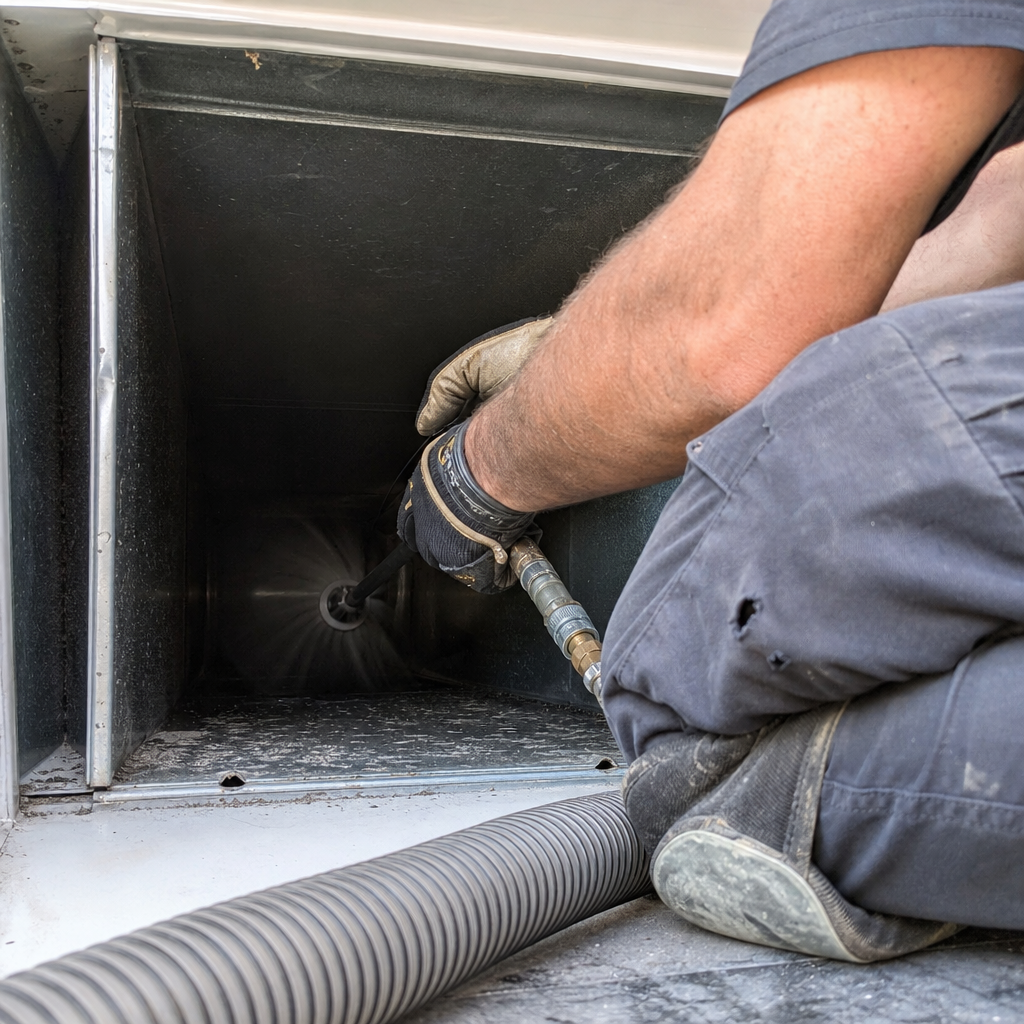
- Contact cleaning of interior duct surfaces using mechanical brushes or air whips
- Negative-pressure debris extraction through access ports
- Cleaning of registers, grilles, and boots
- Visual inspection with cameras or mirrors
We’ve performed thousands of these cleanings across Wichita — in Delano bungalows, Eastborough ranches, and new builds in Bel Aire — and never pulled a permit because the work doesn’t alter the system’s design, materials, or airflow characteristics.
Work that crosses into regulated territory:
- Cutting new access panels into existing ductwork (structural modification)
- Replacing flex duct, duct board, or metal sections (component replacement)
- Sealing seams with mastic or tape that changes system pressure ratings
- Installing UV lights, ionizers, or electronic air cleaners (electrical/HVAC integration)
- Applying antimicrobial or biocide treatments (pesticide application under EPA and KDHE rules)
The Kansas Department of Health and Environment (KDHE) aligns with EPA regulations on antimicrobial treatments specifically. Any product making sanitizing claims in an HVAC system must be EPA-registered for that use, and the applicator must follow label directions precisely. We’ve seen Wichita-area contractors treat this casually, spraying unregistered products through fogging equipment with no documentation.
In our experience, the confusion arises because duct cleaning itself is unregulated at the state level — no Kansas license category exists specifically for it. This creates a vacuum where general maintenance companies, carpet cleaners, and even chimney sweeps add “duct cleaning” without understanding where their work triggers other regulatory frameworks.
What Wichita and Sedgwick County Actually Require
Wichita operates under the Sedgwick County Unified Building and Trade Codes, which incorporate the 2018 IMC with local amendments. For homeowners in Wichita proper, this means permitting runs through the City of Wichita Department of Inspections; unincorporated Sedgwick County residents work through Sedgwick County Code Enforcement.
When permits are required in Wichita/Sedgwick County:
| Work Type | Permit Required? | Where to Verify |
|---|---|---|
| Standard duct cleaning (no modifications) | No | City of Wichita, (316) 268-4528 |
| Duct repair/replacement (any material) | Yes — Mechanical permit | Same as above |
| HVAC equipment replacement | Yes — Mechanical + Electrical | Same as above |
| Mold remediation >10 sq ft in ducts | Yes — may require KDHE notification | KDHE Bureau of Air, (785) 296-6022 |
| Antimicrobial application in commercial | Yes — often requires licensed applicator | KDHE Pesticide Section |
Here’s the practical reality for Wichita homeowners: if your technician arrives with a Rotobrush or Nikro negative-pressure system and cleans what they can reach through existing registers and access points, no permit is needed. If they discover a disconnected flex duct in your attic and offer to “fix it while we’re here,” that repair requires either a mechanical permit or must be performed by a Kansas-licensed mechanical contractor.
We’ve encountered this exact scenario in older Wichita neighborhoods like Crown Heights and McAdams, where original ductwork from the 1950s-70s has deteriorated. The homeowner thinks they’re getting a cleaning; the technician performs an unpermitted repair; and when the system fails to perform later, there’s no inspection record and often no proper scope documentation.
How to verify current requirements:
- Call Wichita Department of Inspections at (316) 268-4528 — ask specifically about “mechanical permit requirements for duct modification”
- Check the Atlas Air Duct & Vent Cleaning Kansas home page for updated local guidance we publish when codes change
- For unincorporated Sedgwick County, contact Code Enforcement at (316) 660-1840
The Kansas climate factor matters here too. Wichita’s wide temperature swings — from summer highs pushing 100°F to winter lows below 10°F — put extraordinary expansion-contraction stress on ductwork. Seams separate, flex duct sags in attics that reach 140°F, and what starts as a cleaning call often reveals damage that genuinely needs repair. The key is transparency about when the work scope changes and what credentials are required for that new scope.
When Mold Remediation Changes Everything
This is where Kansas homeowners face the most significant regulatory gap — and personal liability exposure.
Standard duct cleaning removes settled dust, debris, and particulate matter. It does not, by itself, address active mold growth. Yet we’ve inspected systems in Wichita’s Riverside and Planeview neighborhoods where a “duct cleaning” was sold and performed on visibly mold-contaminated ductwork, spreading spores throughout the home and creating health complaints that triggered insurance disputes.
KDHE’s position on mold in HVAC systems:
Kansas has no standalone mold remediation licensing law, but KDHE references EPA guidelines and the New York City Department of Health Guidelines on Assessment and Remediation of Fungi in Indoor Environments as the practical standard. For HVAC systems specifically, the threshold matters:
- Contamination under 10 square feet in combined surface area: can be addressed by trained maintenance personnel with proper containment
- Contamination exceeding 10 square feet or involving HVAC system interiors: requires professional remediation with containment, negative air pressure, and post-remediation verification
Here’s what this means practically: if your technician opens a duct and finds visible mold growth on the interior surfaces, standard cleaning equipment — even our professional-grade Rotobrush and Nikro systems — is not the appropriate response. The job becomes mold remediation, with different containment requirements, different equipment (we deploy Abatement Technologies HEPA filtration and containment systems for these situations), and different documentation obligations.
Critical distinction for Wichita homeowners:
A technician who cleans mold-contaminated ductwork without proper remediation protocol may:
- Spread contamination to previously clean areas of the system
- Create liability for the homeowner if health issues arise
- Void HVAC manufacturer warranties (most exclude damage from unqualified service)
- Trigger denial of homeowner insurance claims for subsequent mold damage
We’ve been called to remediate after other “cleanings” in Wichita’s older housing stock — particularly in basement and crawl space systems where humidity runs high. The homeowner paid for a cleaning, got a mold distribution system instead, and had no contractual recourse because the scope was never properly defined.
If you suspect mold in your Wichita-area ductwork, ask any prospective contractor specifically: “Do you follow EPA or KDHE-referenced remediation protocols, and do you use containment and HEPA filtration during the process?” If they hesitate or mention “fogging it away,” that’s a credential gap that could cost you significantly.
The Credential Gap in Duct Sealing and Antimicrobial Upsells
This is the most common scope-creep scenario we encounter, and it’s where Wichita homeowners get caught between unpermitted work and unnecessary upsells.
You’re sold a standard duct cleaning. The technician arrives, runs a camera, and shows you “leaky seams” or “bacterial growth.” They offer to seal the ducts with aerosol sealant or spray an “antimicrobial treatment” for an additional charge. The work gets done. No permit is pulled. No credentials are verified. And you’ve potentially paid for work that requires qualifications the technician doesn’t possess.
Duct sealing credentials:
Aerosol duct sealing — the process of pressurizing ducts with adhesive particles that seal leaks from the inside — changes system pressure characteristics and may affect airflow design. In Kansas, this falls under mechanical contractor work if it involves:
- Modifying duct geometry or access points to accommodate the sealing equipment
- Re-certifying system airflow after modification
- Any claim of energy efficiency improvement that affects HVAC equipment sizing
Manual sealing with mastic or foil tape at accessible seams during cleaning is generally maintenance. Aerosol sealing a whole system is not.
Antimicrobial treatment credentials:
Here’s the regulatory reality that surprises even some contractors: EPA-registered antimicrobial products for HVAC use carry application restrictions. The person applying them must:
- Follow the exact label directions (deviation is a federal violation)
- In commercial settings, often hold a pesticide applicator license through KDHE
- Document the product used, concentration, and application method
- Provide safety re-entry intervals for occupants
We’ve reviewed competitor proposals in Wichita where “antimicrobial fogging” was offered as a $149 add-on with no product name specified, no EPA registration number, and no re-entry protocol. That’s not a service — it’s a liability transfer to the homeowner.
At Air Duct Cleaning in Kansas City and across our Wichita service area, we use Guardsman-sourced treatments only where appropriate, with full product documentation, and we clearly separate cleaning scope from treatment scope in our proposals. If a job needs remediation-level work, we say so upfront rather than burying it in an upsell.
How to Protect Yourself Contractually
After 17 years and 276 customer reviews averaging 4.8 stars, we’ve learned that the best protection for Wichita homeowners isn’t regulatory knowledge alone — it’s a clearly scoped contract that defines what work is and isn’t being performed.
Essential contract elements for any duct cleaning:
- Explicit scope definition: “Cleaning of supply and return ductwork via contact brushing and negative-pressure extraction” — not “duct service” or “air system cleaning”
- Exclusion clause: “This scope does not include duct repair, replacement, mold remediation, or antimicrobial treatment unless specified in writing as an addendum”
- Modification protocol: “Any additional work discovered during cleaning will be documented photographically and presented for written approval before proceeding”
- Equipment specification: Specific equipment to be used (professional-grade Rotobrush, Nikro, or equivalent — not “industrial vacuum”)
- Credential verification: For any add-on work, the contractor must specify what licenses or certifications qualify them for that scope
We’ve developed these protections because we’ve seen too many Wichita-area homeowners caught mid-project. A technician finds a disconnected duct in the attic and “fixes it” without stopping to re-scope. Or they spray an antimicrobial without asking, then bill for it. Without contract boundaries, you have no leverage if the work triggers permit requirements or creates liability.
Red-flag language to reject:
- “We’ll assess and address any issues we find” — unlimited scope
- “Full system restoration” — undefined and often unpermitted
- “Mold treatment included” — without remediation protocol documentation
- “Licensed and insured” without specifying license type and number (in Kansas, mechanical contractors hold specific licenses through the Kansas Attorney General’s office)
For homeowners in Wichita’s historic districts — like Old Town or College Hill — this matters acutely. Older systems often need legitimate repair, but that repair should be performed by a Kansas-licensed mechanical contractor with proper permitting, not appended to a cleaning invoice by an unqualified technician.
Inspection Red Flags We See in Wichita Homes
We perform post-cleaning inspections for homeowners who suspect previous work was substandard, and we’ve documented consistent patterns that indicate unpermitted or improperly scoped work.
Physical indicators of scope violations:
- Fresh mastic on seams that weren’t in the original scope: Suggests unpermitted modification
- Cut duct board with no access panel installed: Violates IMC access requirements for future maintenance
- Antimicrobial residue with no product label or SDS provided: Potential EPA violation and occupant exposure risk
- Flex duct spliced with non-rated tape instead of proper collars: Fire and airflow hazard, typically done without permit
- Return plenum modified without matching supply-side capacity: Creates pressure imbalances that damage equipment
Documentation gaps that signal problems:
- No before/after photos of interior duct conditions
- No written scope defining what was and wasn’t performed
- No equipment specification (was it a professional-grade system or a shop vac with a brush attachment?)
- No discussion of findings — a legitimate technician documents what they observed
Wichita’s climate amplifies these issues. Our hot, humid summers and dry, windy winters stress duct materials differently than coastal or northern climates. Improperly sealed seams that might hold in milder climates fail here. Flex duct that’s not properly supported sags and collects condensation in our humidity. We’ve replaced ductwork in Maize and Goddard homes where “cleaning” included unsupported modifications that failed within two seasons.
When we inspect these systems, we document everything photographically and provide written findings that homeowners can use for contractor disputes or insurance claims. The 17 years we’ve spent inside Wichita-area duct systems gives us a baseline for what proper work looks like — and what shortcuts create expensive failures.
Common Mistakes to Avoid
- Hiring based on lowest price without scope verification. Wichita’s market includes operators who advertise $99 whole-house cleanings, then perform minimal contact cleaning and push unscoped upsells. The initial price is irrelevant if the work creates liability.
- Assuming all “duct cleaning” is the same regulatory category. Kansas doesn’t regulate the term, so a carpet cleaner with a shop vac and a specialty firm with Rotobrush and Nikro equipment operate under the same non-licensing — but produce radically different outcomes and liability profiles.
- Approving mid-project changes verbally. When a technician finds “a problem” and offers to fix it immediately, insist on written documentation with specific scope and price before proceeding. Verbal approvals for work that triggers permit requirements are unenforceable.
- Ignoring the mold distinction. Visible mold in ductwork is not a cleaning issue. Treating it as one spreads contamination and creates health liability. In Wichita’s older homes with basement or crawl space systems, this mistake is particularly costly.
- Not verifying contractor credentials for add-on work. If your cleaning contractor offers duct sealing, repair, or equipment installation, ask for their Kansas mechanical contractor license number. If they don’t have one, they cannot legally perform that work.
- Failing to request product documentation for any chemical treatment. EPA-registered products have registration numbers and specific use directions. If your technician can’t provide this, the treatment may be ineffective, illegal, or hazardous.
- Skipping post-work verification in homes with respiratory-sensitive occupants. After any duct work in Wichita, especially in homes with allergy or asthma concerns, request visual documentation of completed work and consider independent air quality testing if mold was previously suspected.
When to Call a Professional
Call a qualified specialist when you notice persistent dust accumulation shortly after cleaning, uneven airflow between rooms, musty odors when the HVAC runs, or visible mold anywhere in the system. These symptoms indicate issues beyond standard maintenance scope — and in Kansas, crossing into repair or remediation territory without proper credentials exposes you to liability.
For Wichita homeowners specifically, consider professional assessment before buying a home with undocumented prior duct work, after any renovation that generated construction dust, or if your system hasn’t been inspected in over five years. Our climate’s thermal stress on materials means problems develop faster than in milder regions.
Atlas Air Duct & Vent Cleaning Kansas offers free estimates in Wichita — call (855) 595-7944. Henry Wood, owner and lead technician, will be on your job, assess your system with professional-grade Rotobrush and Nikro equipment, and clearly distinguish what requires cleaning versus what needs permitted repair or remediation-level response. From cleaning to repair to sanitizing — handled in one visit when scope allows, or clearly referred to appropriately credentialed contractors when it doesn’t.
Frequently Asked Questions
No — standard air duct cleaning that uses contact methods and negative-pressure extraction through existing access points does not require a permit in Wichita or Sedgwick County. However, if the work includes duct repair, replacement, new access panel installation, or antimicrobial treatment, permitting or specialized credentials may be required depending on scope. Call (855) 595-7944 for a free estimate and we’ll clarify exactly what your system needs.
Standard residential duct cleaning in Wichita typically ranges from $300–$600 for a complete system, depending on home size, duct accessibility, and contamination level. Permitted duct repairs or replacements add $150–$400+ depending on materials and mechanical contractor involvement. We provide itemized proposals before any work begins so you understand which category your job falls into.
Only if they hold a Kansas mechanical contractor license for the specific work performed. Kansas does not license “duct cleaning” specifically, but duct modification, replacement, and HVAC-adjacent work falls under mechanical contracting regulations. Always ask for license verification before approving repair work during a cleaning appointment.
Stop the cleaning and request documentation. Mold in ductwork requires remediation protocol, not standard cleaning. In Kansas, contamination exceeding 10 square feet combined surface area should trigger professional remediation with containment, HEPA filtration, and post-remediation verification. We use Abatement Technologies equipment for these situations and clearly separate remediation scope from cleaning scope in our proposals.
Yes — EPA-registered antimicrobial products must be applied according to label directions, and commercial applications often require a KDHE pesticide applicator license. Residential applications occupy a gray area, but any claim of sanitizing or disinfecting HVAC systems triggers federal pesticide regulations. We use only documented, appropriately registered products and provide full application records.
Contact the Wichita Department of Inspections at (316) 268-4528 with your address and approximate work date. For unincorporated Sedgwick County, call (316) 660-1840. Permitted mechanical work should appear in their records. If no permit exists for duct modification or replacement, the work may not meet code and could affect insurance coverage or resale disclosure requirements.
The Bottom Line
Kansas’s regulatory framework for air duct work creates a deceptive simplicity: cleaning itself is unregulated, but the surrounding activities that often accompany it are not. Wichita homeowners who understand this distinction — who demand clear scope definitions, verify credentials for add-on work, and recognize when mold or modification triggers different rules — avoid the liability and substandard outcomes we’ve documented across 17 years of service.
The key protections are straightforward: get the scope in writing, question mid-project scope expansions, verify licenses for any work beyond contact cleaning, and treat mold as remediation, not maintenance. In Wichita’s climate-stressed housing stock, these boundaries matter more than in markets with milder conditions and newer construction.
Written by Henry Wood, Owner & Lead Technician at Atlas Air Duct & Vent Cleaning Kansas, serving Wichita since 2009.