
Last updated July 11, 2026
The Complete Guide to Air Duct Cleaning in Wichita
After 17 years inside Wichita-area duct systems, the most common thing Henry Wood finds isn’t dangerous mold — it’s a homeowner who paid for a cleaning when their actual problem was a disconnected trunk line behind the drywall. In Wichita’s market, where wind-driven prairie dust meets clay-heavy soil that settles into slab foundations differently than anywhere else in Kansas, duct issues masquerade as dirt problems every day. This guide teaches you to read your own system before you spend a dollar, so you hire for the right reason instead of reacting to a marketing mailer promising “$99 whole-house specials.”
Quick Answer
Professional air duct cleaning in Wichita typically costs $300–$700 for a standard single-family home and should only be performed after confirming your system actually needs it — most “dirty” ducts in Wichita are actually symptoms of disconnected lines, failed seals, or normal accumulation that doesn’t affect airflow. A legitimate cleaning uses negative-pressure truck-mount or portable HEPA systems (like Nikro or Rotobrush units) to extract debris without releasing it into your living space, and takes 3–5 hours for thorough work.
Table of Contents
- How to Inspect Your Own Ducts Before Calling Anyone
- Why Wichita’s Climate Loads Your Ducts Differently
- Cosmetic Dust vs. Functional Contamination: Know Which You Have
- What Professional Equipment Actually Looks Like
- Red Flags Specific to Wichita’s Duct Cleaning Market
- What Happens During a Legitimate Duct Cleaning
- What Duct Cleaning Costs in Wichita
- Maintaining Your Ducts Between Professional Cleanings
How to Inspect Your Own Ducts Before Calling Anyone
Here’s what most Wichita homeowners never do: look inside their own system with a flashlight and a screwdriver. In 17 years of service calls, Henry Wood has arrived at homes in Riverside, College Hill, and the Delano district where residents were convinced they needed full duct cleaning — only to find a completely different issue that no amount of brushing would fix.
Step 1: Check your supply registers
Remove two or three vent covers from different rooms — one near the air handler, one far away. Look past the grille into the duct boot (the metal box behind the wall). You’re checking for:
- Thick, fuzzy buildup that reduces the visible duct diameter by more than a third
- Construction debris: drywall chunks, wood scraps, or insulation fragments from original build or renovation
- Standing water or damp, musty-smelling residue
- Disconnected flex duct that’s collapsed or pulled away from the boot
Step 2: Inspect your return grilles
Return ducts pull air back to your system, so they collect what floats in your home. In Wichita’s windy months — especially March through May and October — these get loaded with fine topsoil particulate that’s distinct from normal household dust. Remove the filter first (note the date you last changed it), then shine a light into the return plenum. Heavy, uniform coating across all returns suggests system-wide accumulation. Spotty or isolated buildup suggests a localized problem.
Step 3: Open the blower compartment
Turn off power at the breaker, remove the furnace panel, and photograph what you see. The blower wheel and evaporator coil tell the real story. If these are caked with debris, your ducts are likely circulating contamination regardless of how clean the visible register looks. If they’re relatively clean but you’re experiencing poor airflow, you likely have a duct leakage or design problem — not a contamination problem.
Step 4: Document and date everything
Take dated photos. When Henry Wood arrives at a Wichita home for an estimate, customers who’ve done this preliminary inspection get accurate diagnoses faster. We’ve seen homeowners in the Crown Heights and Sleepy Hollow areas catch disconnected flex duct behind drywall that was costing them 30% airflow loss — a $200 repair, not a $500 cleaning.
Why Wichita’s Climate Loads Your Ducts Differently
Wichita sits at the convergence of multiple air masses, and that geography shows up inside your ductwork. Understanding this helps you distinguish normal accumulation from genuine problems.
Wind-driven particulate
The south-central Kansas plains generate sustained winds of 15–25 mph for significant portions of the year, with spring gusts regularly exceeding 40 mph. Wichita’s loamy, clay-heavy soil produces fine particulate that infiltrates homes through envelope gaps — around windows, doors, attic hatches, and recessed light fixtures. This dust has a distinctive reddish-tan color and gritty texture. It accumulates in return ducts faster than in supply ducts because returns create negative pressure that pulls air (and dust) from your living space.
Clay soil and slab foundations
Unlike eastern Kansas homes with basements that separate HVAC equipment from soil contact, many Wichita homes — particularly post-1950s construction in neighborhoods like Westlink, Orchard Breeze, and most of the city’s west side — sit on slab foundations with ductwork embedded in or beneath the concrete. Clay soil expands and contracts dramatically with moisture changes. This movement stresses duct seams and can create gaps where soil particulate enters the system directly. We’ve found red clay dust packed into supply boots in Wichita homes where the homeowner had never connected “dirty ducts” to their foundation type.
Seasonal humidity swings
Wichita’s relative humidity ranges from 15% in winter to 80%+ in summer. These swings affect what grows — or doesn’t — inside ducts. Unlike Gulf Coast or Pacific Northwest markets where mold concerns dominate, Wichita’s dry winters typically prevent active mold colonization in properly functioning systems. When we do find biological growth in Wichita ducts, it’s almost always associated with a specific moisture intrusion: a clogged condensate drain, a humidifier set too high, or a crawl space duct that’s contacted groundwater.
Temperature differentials and thermal loss
Wichita’s 100°F+ summer days and single-digit winter nights create extreme duct temperature swings. In unconditioned attics — common in Wichita’s 1960s–1980s housing stock — flex duct can degrade faster than in milder climates. The insulation jacket separates from the inner liner, creating pockets where debris collects and airflow restriction develops.
Cosmetic Dust vs. Functional Contamination: Know Which You Have
This distinction saves Wichita homeowners hundreds of dollars annually. Not all “dirty” ducts need cleaning. Here’s how to tell the difference.
Cosmetic accumulation (usually doesn’t need cleaning)
- Thin, uniform dust coating on register grilles — wipes off with a damp cloth
- Visible particles within 6 inches of the register face, but clean duct walls deeper in
- Dust that reaccumulates within 2–3 weeks of wiping — indicates high household dust generation or poor filtration, not duct contamination
- No change in airflow volume or temperature delivery over time
- No allergy symptoms that correlate with HVAC runtime
Functional contamination (legitimate cleaning candidate)
- Buildup that visibly narrows duct cross-section by 25% or more
- Debris that releases into the room when airflow starts (visible puff at register startup)
- Persistent musty or chemical odors that intensify when the system runs
- Documented airflow reduction: rooms that used to heat/cool effectively now don’t
- Post-renovation debris: drywall dust, sawdust, or insulation particulate from recent remodeling
- Pest evidence: rodent droppings, insect casings, or nesting material
In our experience across Wichita’s 67203, 67212, 67226, and 67235 ZIP codes, roughly 60% of homeowners who request duct cleaning estimates actually have cosmetic accumulation or a non-contamination problem. The other 40% have legitimate functional contamination — but even among that group, about half also have underlying duct leakage or damage that cleaning alone won’t fix.
Henry Wood’s approach on every Wichita estimate: inspect first, diagnose second, recommend third. We’ve turned down cleaning jobs in the Indian Hills and Bel Aire areas when the real issue was a disconnected trunk line or a failed duct seal that would have rendered any cleaning pointless.
What Professional Equipment Actually Looks Like
The equipment difference separates remediation-grade work from surface-level sweeping. Here’s what legitimate duct cleaning equipment looks like — and why it matters in Wichita’s particulate environment.
Negative-pressure collection systems
A professional duct cleaning creates negative pressure throughout the duct network, extracting debris rather than dislodging it into your home. This requires:
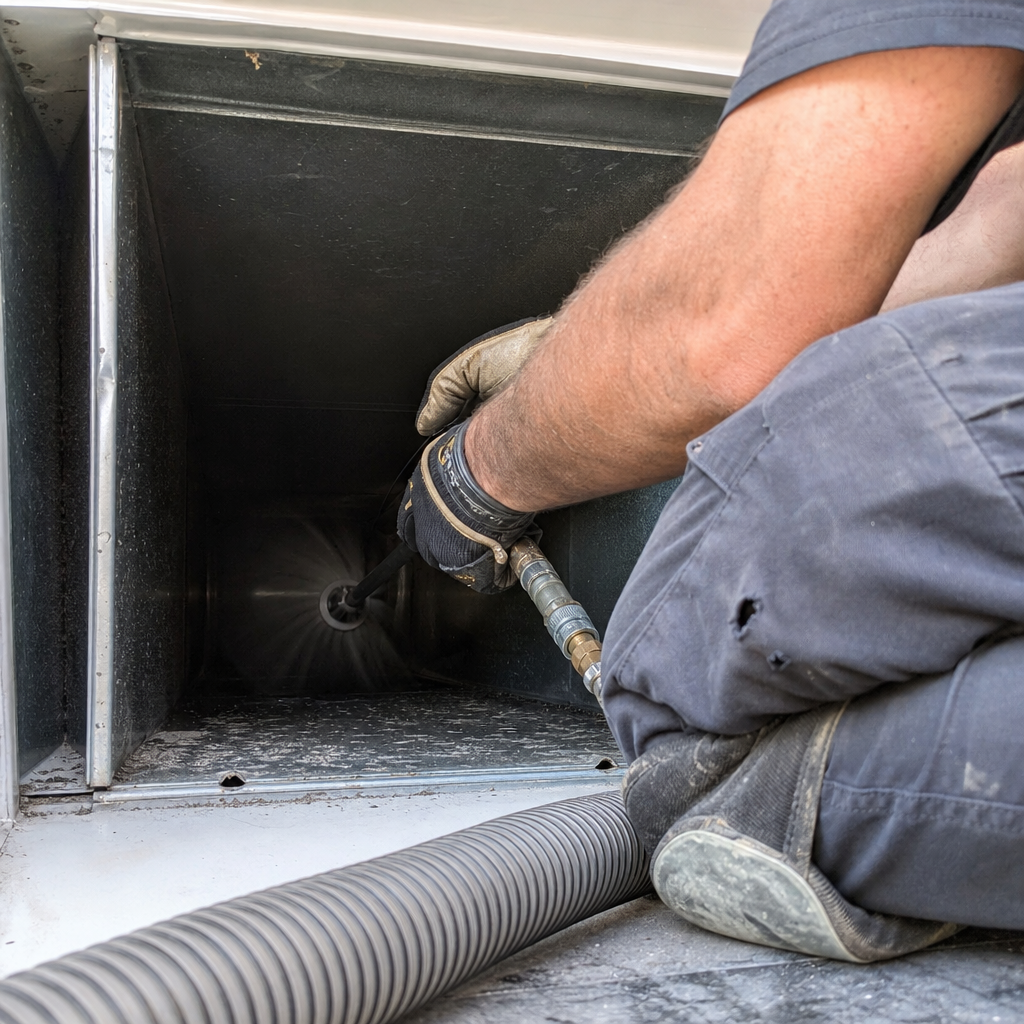
- High-volume HEPA vacuums: Nikro portable units or truck-mounted systems pulling 5,000+ CFM. These maintain negative pressure sufficient to prevent debris escape during agitation. Residential shop vacs — even “HEPA” labeled ones — typically move 100–200 CFM, insufficient for duct containment.
- Sealed collection containment: Abatement Technologies filtration on exhaust, ensuring captured particulate doesn’t recirculate. In Wichita’s fine-dust environment, this matters enormously — clay particulate is sub-10-micron and remains airborne for hours without proper containment.
- Agitation tools that match duct material: Rotobrush contact-cleaning systems for metal ductwork, soft-bristle whips for flex duct, and pneumatic tools for stubborn buildup. The wrong tool damages duct lining or fails to dislodge debris.
What we don’t use — and why
We’ve encountered “duct cleaning” crews in Wichita operating with nothing more than a shop vac, a rotary brush on a drill, and a leaf blower. This equipment doesn’t create negative pressure. It dislodges debris into your living space, where the finest — and most respirable — particles remain suspended for hours. In a home with asthma or allergy sufferers, this “cleaning” can worsen air quality for days.
Access and inspection tools
Professional work requires visual verification. We use borescope cameras to inspect before and after, documenting actual results. In 17 years, we’ve never had a customer regret seeing photographic evidence of what was — and wasn’t — in their system.
Red Flags Specific to Wichita’s Duct Cleaning Market
Wichita’s home services market has specific warning signs that differ from national patterns. Here’s what to watch for.
Bait-and-switch pricing on arrival
The “$99 whole-house special” advertised on mailers and social media rarely survives the front door. We’ve heard from Wichita homeowners in the College Hill and Riverside areas who were quoted $99 on the phone, then presented with $800+ charges after the technician “discovered” mold, extra vents, or “required” sanitizing. Legitimate pricing requires seeing the system — but legitimate companies provide binding written estimates before work begins, not after arrival.
Technician turnover and franchise dispatch
National franchise operations serving the Wichita market rotate technicians frequently. The person who quotes your job may never enter your home. The actual worker might be two weeks into the role, following a script rather than assessing your specific system. When Henry Wood responds to a Wichita estimate request, Henry Wood is who arrives — the same person with 17 years of accumulated pattern recognition.
No NADCA reference or equivalent standard
The National Air Duct Cleaners Association (NADCA) establishes assessment and cleaning standards. Reputable Wichita providers reference these standards in quotes and can explain how their process complies. Absence of any standard reference suggests either ignorance or intentional vagueness — neither serves your interests.
Immediate upselling without inspection
Technicians who recommend sanitizing, sealing, or “mold remediation” before examining your system are selling, not diagnosing. In 17 years, we’ve encountered actual duct mold in Wichita homes fewer than two dozen times — always associated with identifiable moisture problems. Mold claims without moisture evidence warrant skepticism.
Pressure to decide immediately
“Today’s only” pricing, scare tactics about family health, or refusal to provide written estimates for comparison shopping — these are sales pressure techniques, not professional service practices. Atlas Air Duct & Vent Cleaning Kansas provides written estimates valid for 30 days, with no obligation.
What Happens During a Legitimate Duct Cleaning
Understanding the actual process helps you evaluate what you’re paying for and recognize shortcuts.
Pre-inspection and documentation (30–45 minutes)
We photograph registers, returns, blower compartment, and accessible trunk lines. We test airflow at multiple registers with a calibrated anemometer. This establishes baseline performance and identifies problems cleaning won’t solve. In a 2023 job near Wichita’s Towne East area, this inspection revealed a completely disconnected 8-inch flex duct behind a master bedroom wall — the source of a two-year “hot room” complaint that three previous HVAC contractors had never diagnosed.
System protection and containment setup (20–30 minutes)
Registers are sealed or protected. The HVAC system is isolated to prevent debris migration. Negative-pressure equipment is connected — typically at the air handler or a central trunk access point. In Wichita’s older homes with original metal ductwork, we often find it necessary to create temporary access panels to reach all trunk branches; these are properly sealed afterward.
Agitation and extraction (2–3 hours)
Each register and return receives individual attention. Rotobrush contact-cleaning systems scrub metal duct walls; pneumatic whips dislodge debris from flex duct without damaging the liner. Debris is immediately drawn into the negative-pressure collection system. We work from the farthest point back to the air handler, ensuring nothing is pushed toward living spaces.
Component cleaning
The blower wheel, evaporator coil (if accessible), and plenum receive specific attention. These components affect air quality as directly as ductwork. HVAC Cleaning in Kansas City follows identical protocols — the equipment and standards don’t change across our service area.
Post-cleaning verification
We re-photograph accessible areas, retest airflow, and provide documentation. If we found problems beyond cleaning scope — disconnected ducts, failed seals, degraded flex — we explain these separately with repair options. From cleaning to repair to sanitizing, handled in one visit.
What Duct Cleaning Costs in Wichita
Legitimate duct cleaning in Wichita follows predictable cost structures based on system size and condition. Here’s what to expect.
| Service Component | Typical Wichita Range | What Affects Price |
|---|---|---|
| Standard single-family home (1,200–2,400 sq ft) | $300–$550 | Number of registers/returns, duct accessibility, contamination level |
| Larger home or complex layout (2,400–4,000 sq ft) | $500–$800 | Multiple HVAC systems, zoned ductwork, attic/crawl access difficulty |
| Post-renovation cleaning | $400–$700 | Construction debris volume, drywall dust infiltration extent |
| Component cleaning (blower, coil) | $150–$300 additional | Accessibility, contamination type, refrigerant handling requirements |
| Duct repair/sealing identified during cleaning | $200–$600 | Location of damage, materials needed, access difficulty |
Prices below $250 for whole-house cleaning in Wichita should trigger scrutiny. At that price point, providers are either using inadequate equipment, rushing the job, or planning to upsell on arrival. We’ve been called to correct “cleaned” systems in the Derby and Haysville areas where the previous crew spent under 90 minutes on a 2,500-square-foot home — visibly leaving debris in trunk lines.
Atlas Air Duct & Vent Cleaning Kansas offers free estimates in Wichita — call (855) 595-7944 for exact pricing based on your specific system.
Maintaining Your Ducts Between Professional Cleanings
Most Wichita homeowners can extend intervals between professional cleanings with specific maintenance practices.
Filter discipline
Use MERV 8–13 pleated filters, changed every 60–90 days during high-use seasons. In Wichita’s spring dust season (March–May), inspect monthly. Never run without a filter — the blower pulls unfiltered air directly into your system. We’ve replaced blower wheels in Wichita homes where this single oversight caused $400+ damage.
Register and grille maintenance
Vacuum registers monthly with a brush attachment. Remove and wash grilles annually. This addresses cosmetic accumulation before it migrates deeper into the system.
Humidity management
Keep indoor relative humidity between 30–50%. In Wichita’s humid summers, this may require dehumidification. Excess moisture creates conditions for biological growth that dry prairie air typically prevents.
Post-renovation protocol
Any renovation generating dust — drywall work, flooring, demolition — should include return grille sealing and post-project filter replacement. Consider professional cleaning if dust was visibly generated with the HVAC running. Air Duct Cleaning in Kansas City follows identical post-renovation protocols.
Annual visual inspection
Repeat the register and blower compartment inspection described in Section 1 annually. Document with photos. Changes year-over-year reveal developing problems before they become expensive.
Common Mistakes to Avoid
- Scheduling cleaning without inspection. In Wichita’s market, where foundation movement and wind infiltration create unique duct stress, cleaning a disconnected or leaking system wastes money and masks the real problem.
- Ignoring the air handler. A clean duct network connected to a contaminated blower wheel recirculates debris immediately. Component cleaning is not an upsell — it’s integral to results.
- Choosing by price alone. The $199 special in Wichita typically involves 90 minutes, a shop vac, and no verification. We’ve re-cleaned these jobs within months.
- Assuming all “dust” is equal. Wichita’s red clay particulate is abrasive and fine; it requires different agitation than the larger, fluffier dust typical of humid climates. Equipment not matched to local particulate characteristics underperforms.
- Neglecting dryer vents while focusing on ducts. Dryer vent buildup creates fire risk and can backpressure lint into connected ductwork. Dryer Vent Cleaning in Kansas City addresses this directly — and should be part of your maintenance calendar.
- Accepting “mold” diagnoses without evidence. In Wichita’s dry climate, duct mold is rare without identifiable moisture intrusion. Demand photographic or laboratory evidence before authorizing remediation-level work.
- Forgetting post-cleaning verification. Without before/after documentation, you have no proof of work quality. Reputable providers supply this automatically.
When to Call a Professional
Call for professional assessment when: you’ve completed the self-inspection and found functional contamination; airflow has measurably declined in specific rooms; odors intensify with HVAC operation; you’ve completed renovation work with the system running; or it’s been 5–7 years since any professional duct service and your home has high occupancy or pet presence.
Atlas Air Duct & Vent Cleaning Kansas offers free estimates in Wichita — call (855) 595-7944. Henry Wood, owner and lead technician, will be on your job, bringing 17 years inside duct systems and professional-grade Rotobrush and Nikro equipment. 276 customers reviewed us at 4.8 stars. We’ll inspect first, tell you honestly whether cleaning is appropriate, and handle whatever your system actually needs.
Frequently Asked Questions
Professional duct cleaning in Wichita typically ranges from $300 to $700 for standard single-family homes, depending on system size, accessibility, and contamination level. Homes larger than 2,400 square feet or those with multiple HVAC systems may run higher. Call (855) 595-7944 for a free exact quote — estimates are free and valid for 30 days.
Most Wichita homes benefit from professional duct inspection every 3–5 years, with actual cleaning needed only when functional contamination is found. Homes with pets, recent renovations, or occupants with respiratory sensitivities may need more frequent service. Wichita’s dry climate generally slows biological growth compared to humid regions, so “annual cleaning” is rarely necessary here.
Homeowners can and should perform basic register cleaning and filter changes, but thorough duct cleaning requires negative-pressure equipment and access tools that aren’t available for consumer purchase. Attempting deep cleaning with household vacuums risks damaging flex duct liner and releasing fine particulate into living spaces without containment. For Wichita’s clay-heavy dust, professional extraction is the safer approach.
Duct cleaning is legitimate when performed for the right reasons with proper equipment — but the industry has earned skepticism through bait-and-switch pricing and unnecessary upselling. In Wichita specifically, we’ve found that about 40% of requested cleanings are genuinely needed; the rest are better addressed through repair, sealing, or filter upgrades. The key is accurate diagnosis before any work begins.
Cleaning alone rarely produces measurable energy savings unless ducts were severely obstructed. However, the inspection process often reveals duct leakage, disconnected runs, or insulation failures that do waste energy — and these can be repaired during the same visit. In Wichita’s climate with extreme seasonal temperature swings, sealed and intact ductwork matters more than clean ductwork for efficiency.
Legitimate providers: use NADCA or equivalent standards in quotes; specify equipment brands and models; provide written, itemized estimates before work begins; offer post-cleaning verification; and can explain why your specific system needs service rather than applying a universal recommendation. In Wichita, also verify whether the person quoting is the person doing the work — owner-operators like Henry Wood provide accountability that rotating franchise technicians cannot match.
The Bottom Line
Most Wichita homeowners who think they need duct cleaning actually need a diagnosis first. This guide’s self-inspection steps — checking registers, returns, and the blower compartment — take 30 minutes and prevent spending on the wrong solution. Wichita’s unique combination of wind-driven prairie dust, clay soil, and slab-foundation ductwork creates patterns that differ from national norms: disconnected trunk lines masquerade as dirty ducts, and normal accumulation gets mistaken for functional contamination.
When cleaning is genuinely needed, demand negative-pressure equipment with HEPA containment, documented before/after verification, and a technician who can explain your specific system’s condition rather than reciting a sales script. From Riverside to Bel Aire, from Delano to the east side’s newer construction, the principles hold: inspect, diagnose, then treat — in that order.
Written by Henry Wood, Owner & Lead Technician at Atlas Air Duct & Vent Cleaning Kansas, serving Wichita since 2009.