
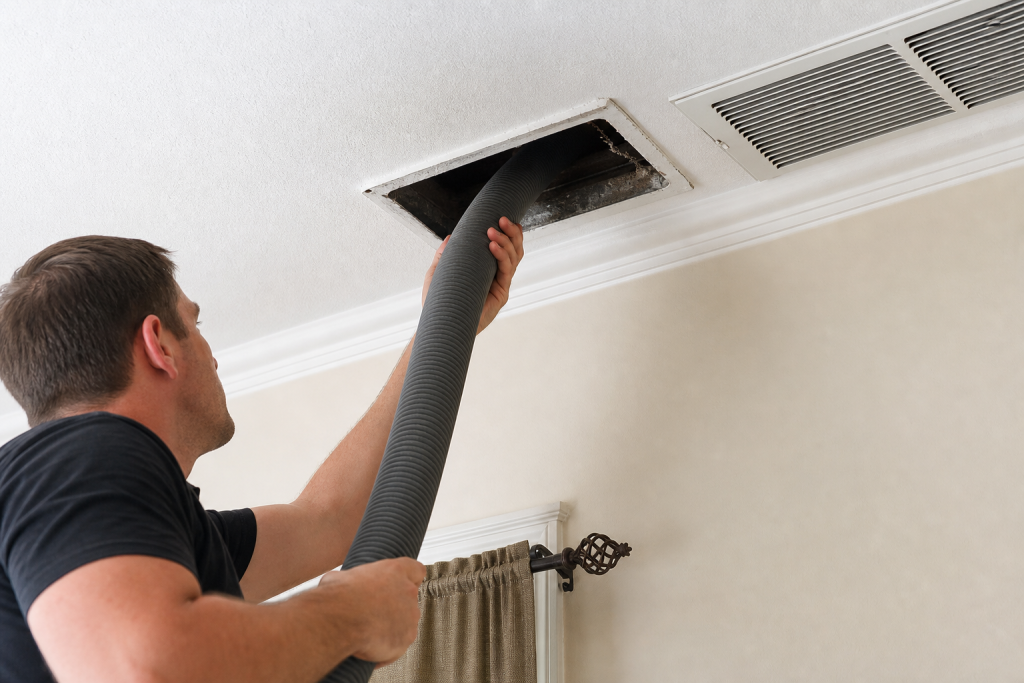
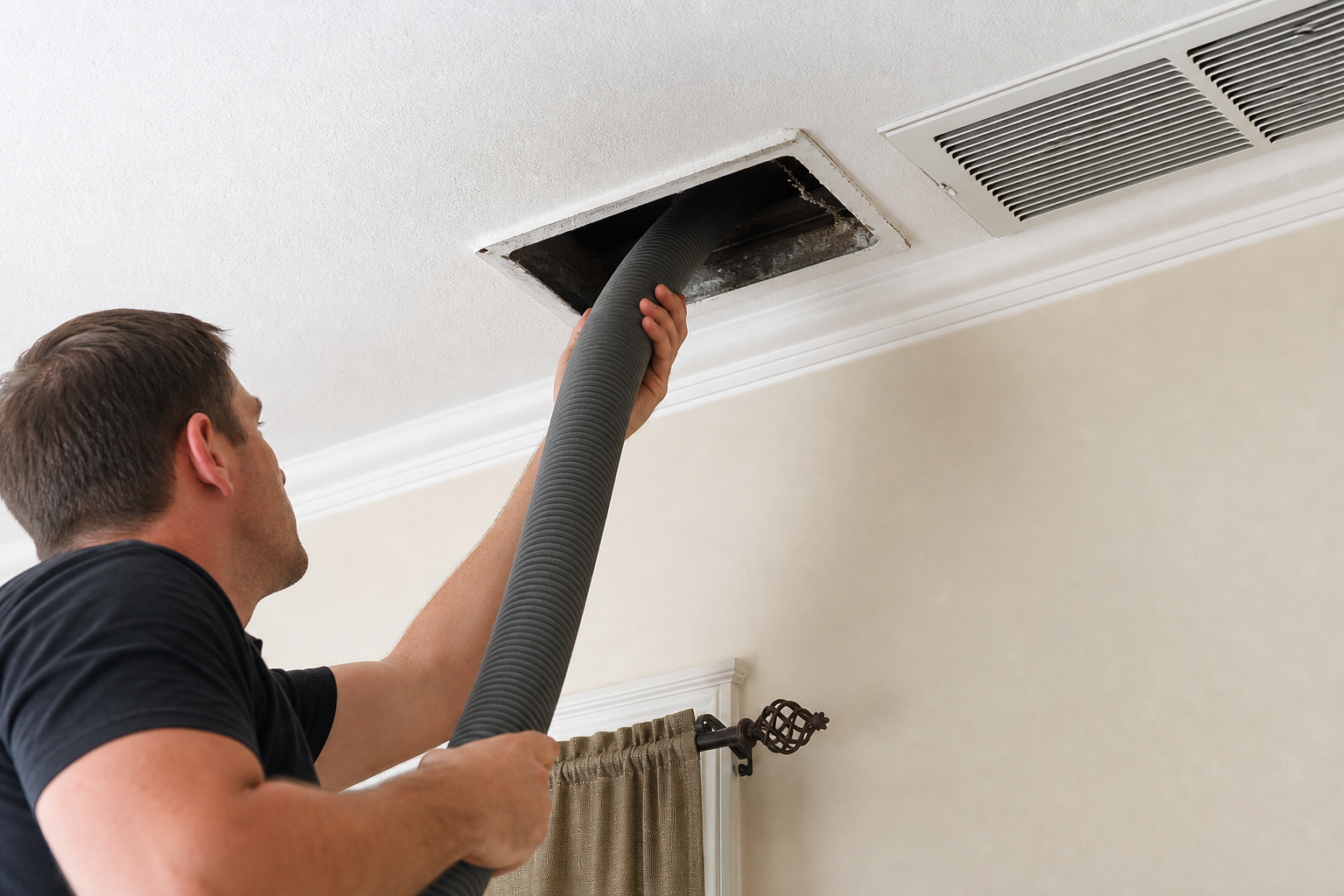
How to Choose the Right Air Duct Cleaning Company in Wichita
The right air duct cleaning company in Wichita is one whose lead technician can inspect your system and immediately identify your duct board type, your vent configuration, and the specific access points needed for a thorough cleaning — without upselling you on services you don’t need. Look for owner-operated firms with professional-grade negative-pressure equipment, verifiable technician continuity, and the ability to handle repairs or sanitizing in the same visit. If you’d rather not sort through the options yourself, call Atlas Air Duct & Vent Cleaning Kansas at (855) 595-7944 for a free estimate.
Here’s the mistake we see most often in Wichita: homeowners choose based on who has the most Google reviews or the lowest coupon price, then watch a crew spend 45 minutes in their home and leave the system barely cleaner than when they arrived. The companies spending the most on advertising are typically the most dependent on volume — and volume-dependent crews cut corners on the one thing that actually matters: contact time inside the duct system.
Ask These Technical Questions Before You Book
A knowledgeable technician should answer these without hesitation. If you get pauses, scripts, or deflections, you’re talking to a sales-trained crew, not a duct specialist.
“What type of duct board am I looking at, and how does that change your approach?”
Fiberglass duct board, flex duct, and galvanized metal each require different contact methods. A technician who can’t distinguish them on sight — or worse, says “we treat them all the same” — is using a one-size-fits-all process that won’t clean thoroughly and may damage sensitive materials. In our 17 years inside Wichita duct systems, we’ve seen flex duct torn by aggressive brushing and fiberglass board delaminated by excessive vacuum pressure. The answer you want: specific tool and pressure adjustments for your duct type.
“How do you access the main trunk line?”
Cutting corners means cleaning only the visible vents and skipping the trunk. The correct answer involves creating sealed access points or using existing service openings — not just pushing a brush down each register.
“What’s your negative pressure at the vacuum source, and how do you maintain it throughout the run?”
A real professional-grade setup — like our Nikro negative-pressure vacuums — maintains sufficient suction to capture dislodged debris without losing seal. A rebranded shop vacuum can’t maintain consistent pressure across a typical Wichita home’s 150+ linear feet of ductwork.
Why Technician Continuity Matters More in Duct Work
In most home services, rotating crews are an inconvenience. In duct cleaning, they’re a quality failure.
Here’s why: duct systems are fingerprinted by their original installer, subsequent repairs, and decades of modifications. The technician who cleaned your neighbor’s 1970s Delano home last month learned that the main return drops behind a finished wall in that specific floor plan. That knowledge doesn’t transfer to a new hire with a checklist app.
At Atlas Air Duct & Vent Cleaning Kansas home, Henry Wood, owner and lead technician, will be on your job — the same person who’s been inside Wichita duct systems since 2009. We’ve serviced homes in Riverside, College Hill, and the Crown Heights historic district where every system has its own quirks from previous renovations. When we return for maintenance, we remember your setup. Franchise crews with 40% annual turnover can’t offer that.
Ask prospective companies: “Who specifically will be in my home, and how many duct cleanings have they personally completed?” If they can’t name the technician or the number, you’re buying a dispatch lottery.
How to Verify Equipment Claims on Arrival
Marketing language about “truck-mounted power” is easy to write. The actual equipment tells the real story.
Here’s what to look for when the truck pulls up:
- Negative-pressure vacuum: Should be a dedicated unit — Nikro or equivalent — with visible HEPA filtration and a collection drum sized for the job, not a modified wet/dry vacuum with a longer hose.
- Contact-cleaning agitation: Rotobrush systems or equivalent powered brushes with variable speed control, not manual fiberglass rods or compressed-air whips alone.
- Containment capability: For homes with mold concerns or post-renovation cleanup, remediation-grade equipment like Abatement Technologies systems for particulate control and proper exhaust.
- Visual verification tools: Borescope or camera system to inspect before and after — if they can’t show you, they didn’t thoroughly clean.
We pulled one out of a garage over in Eastborough last month where the previous “duct cleaning” company had used a residential vacuum with a 50-foot hose run from their van. The homeowner still had construction dust from a 2022 renovation packed in the return trunk. The equipment gap isn’t subtle once you know what to look for.
NADCA Certification vs. NADCA “Standards” — Know the Difference
This distinction trips up even informed buyers.
NADCA-certified company: Appears on the National Air Duct Cleaners Association’s official directory, has met membership requirements including insurance verification, and employs at least one Air Systems Cleaning Specialist (ASCS) who has passed NADCA’s examination. You can verify this in 30 seconds on NADCA’s website.
References “NADCA standards” in marketing: Means they’ve read the guidelines, possibly attended a seminar, but carries no verification requirement, no inspection, and no ongoing accountability. It’s the difference between a licensed electrician and someone who “follows electrical best practices.”
In Wichita’s market, we’ve seen multiple companies claim “NADCA-compliant procedures” while using equipment and methods that violate NADCA’s own published standards. The compliance claim sounds official; the certification check takes less than a minute. Do the check.
Owner-Operated vs. Franchise: Accountability Structure
The business model shapes everything about your service experience.
| Factor | Owner-Operated | Franchise / Volume Model |
|---|---|---|
| Who does the work | Owner or long-term employee with direct stake | Rotating technicians, often commission-based upsell incentives |
| Equipment ownership | Purchased and maintained for longevity | Leased or minimum-spec, replaced on corporate schedule |
| Who answers complaints | Owner — phone, reputation, livelihood on the line | Call center, regional manager, corporate escalation |
| Pricing pressure | Covers proper time and materials | Volume targets drive speed over thoroughness |
| Service scope | Can adapt to findings during job | Strict menu, second visit required for additional work |
When something goes wrong — a missed trunk line, a damaged register, a seal that fails after cleaning — the owner-operator’s entire local reputation depends on making it right. For a franchise technician, it’s a write-up at best. That structural difference changes how carefully the work gets done.
Our full indoor air quality scope — from Air Duct Cleaning in Kansas City to HVAC Cleaning in Kansas City, duct repair and sealing, and air sanitizing — means problems found during your Wichita job get handled in one visit, not rescheduled with a second company.
Red Flags We See in Wichita Competitor Practices
After 17 years in this market, these patterns predict a bad outcome:
- “Whole house” flat pricing without inspection: A 1,200-square-foot ranch and a 3,500-square-foot two-story with zone dampers require different time and access. Flat pricing without seeing the system means they’re planning to spend the same minimal time regardless.
- Immediate upselling on “mold” or “sanitizing” before cleaning: Legitimate mold concerns require lab-verified testing, not a flashlight and a worried expression. We use Abatement Technologies equipment for actual remediation scenarios, not as a scare-tactic add-on.
- No visual before/after documentation: If they won’t show you the inside of your ducts, they don’t want you to see the results.
- Pressure to book “today only” pricing: Professional duct cleaning isn’t an impulse purchase. The urgency is manufactured.
Related services in Wichita: If your system needs more than cleaning, we also handle Dryer Vent Cleaning in Kansas City and the full range of HVAC maintenance and repair work.
Key Takeaways
- Technical fluency — duct board types, access methods, pressure specifications — separates specialists from sales crews.
- Same-technician continuity matters: duct systems carry history that rotating crews can’t learn from a work order.
- Verify equipment on arrival: professional-grade negative-pressure systems look and perform nothing like modified shop vacuums.
- Check NADCA certification directly, not marketing claims about “standards.”
- Owner-operated structure creates accountability that franchise volume models structurally cannot replicate.
The Bottom Line
Choosing the right duct cleaning company in Wichita comes down to one question: who’s actually going to be inside your system, with what equipment, and what happens when they find something unexpected? The companies optimized for volume have optimized away the time and expertise needed to answer well.
At Atlas Air Duct & Vent Cleaning Kansas, Henry Wood handles every service call as lead technician, backed by 17 years of specialized duct work and professional-grade Rotobrush and Nikro systems. Our 276 customers reviewed us at 4.8 stars — not because we’re the cheapest option, but because we do the work correctly the first time. If you’re in Wichita and want an honest assessment of what your system actually needs, call (855) 595-7944 for a free estimate.
Frequently Asked Questions
Professional duct cleaning in Wichita typically ranges from $300 to $700 for a standard residential system, depending on home size, duct accessibility, and contamination level. Be wary of sub-$200 offers — they indicate minimal contact time and often exclude trunk line cleaning. Call (855) 595-7944 for an exact quote based on your specific system — estimates are free.
The NADCA recommends every 3 to 5 years for typical homes, or sooner after renovations, pest infestations, or if occupants have allergy sensitivities. In Wichita, we see accelerated buildup in homes near active construction zones or with older galvanized ductwork common in pre-1980s neighborhoods. If you’re unsure whether your system is due, a camera inspection removes the guesswork.
Temporarily, yes — if done incorrectly. Disturbing debris without adequate negative pressure containment can release particulates into living spaces. This is why proper equipment matters: our Nikro systems maintain continuous suction during agitation, and we seal registers before work begins. A properly executed cleaning reduces airborne allergen load; a rushed job can do the opposite.
A complete residential cleaning takes 3 to 5 hours for a typical Wichita home, longer for larger systems or those requiring access point creation. Any company quoting 60 to 90 minutes is cleaning registers only, not the full duct network. The contact time inside your system is what determines results — speed is the enemy of thoroughness.
Written by Henry Wood, Owner & Lead Technician at Atlas Air Duct & Vent Cleaning Kansas, serving Wichita since 2009.
Need Air Duct Cleaning Help?
Call Atlas Air Duct & Vent Cleaning Kansas — licensed & insured, available 24/7 in Kansas.
(855) 595-7944