
Signs You Need Dryer Vent Cleaning in Kansas, KS — Catch the Problem Before Your Dryer Fails
By the time your dryer needs two cycles to finish a load, the lint restriction in your vent is already a fire risk. The signs worth knowing are the ones that show up six months before that: clothes slightly hotter than usual at cycle end, a faint burning smell only during the first ten minutes, and your exterior vent flapper staying open for fewer minutes per cycle. These early signals mean heat is backing up and exhaust velocity is dropping — and in Kansas City homes with long interior vent runs, that happens faster than most homeowners realize. If you’re seeing any of these, call Atlas Air Duct & Vent Cleaning Kansas at (855) 595-7944 for a free assessment.
Why Kansas City Homes Hide Dryer Vent Problems Longer Than They Should
Henry Wood, owner and lead technician at Atlas Air Duct & Vent Cleaning Kansas, has spent 17 years crawling into duct systems across the metro. He’s seen the same pattern repeat: a homeowner in Rosedale or Argentine calls after the dryer stops working, and the vent run is packed solid with lint that started building two years ago. The problem stayed hidden because Kansas City’s housing stock creates perfect conditions for slow, invisible restriction.
Here’s what makes our local homes different. The ranch-style and split-level houses built across Kansas City, Kansas from the 1950s through the 1980s typically put laundry rooms in the interior — not on an exterior wall. That means vent runs of 15 to 25 feet with two or three elbows before reaching the roof or a distant wall cap. Compare that to a modern home with a six-foot straight shot through an exterior wall. Every foot of run and every 90-degree elbow reduces airflow velocity and gives lint a surface to cling to. In our climate, that lint also picks up seasonal humidity that compresses it into dense mats.
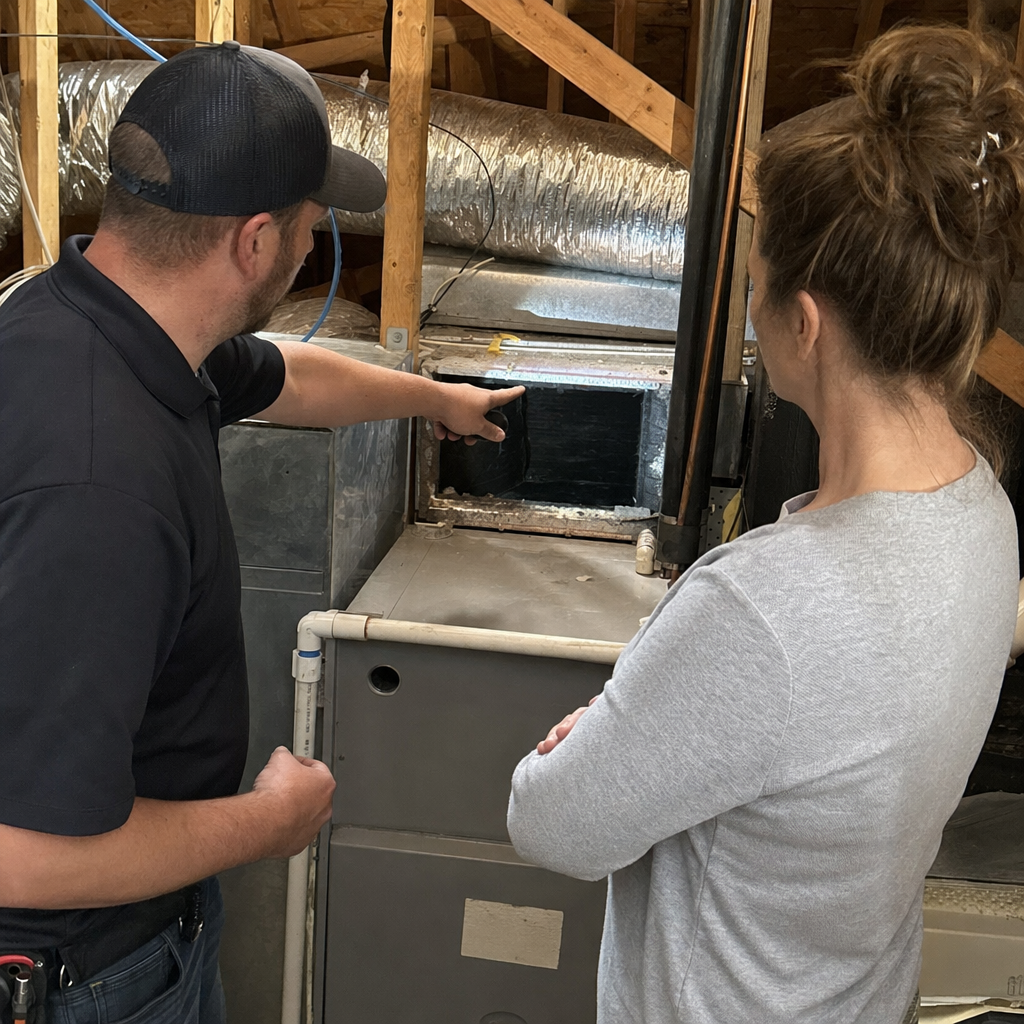
We’ve pulled intact bird nests from vent termini in Piper and found crushed flexible ductwork buried behind finished basements in Turner. The homeowners had no idea until we ran our camera. That’s why we don’t just blow air through and call it clean — we inspect the full run with visual and camera checks to find what’s actually wrong back there.
I’ve been in enough duct systems around here to know what clean looks like — and most of what I open up isn’t it.
The Early-Stage Signs Most Articles Skip
Most “signs you need dryer vent cleaning” lists start with doubled drying time and a hot exterior dryer panel. By then, you’re past warning signs and into emergency territory. Here are the subtler signals that show up months earlier, when cleaning is preventive rather than rescue work.
Clothes Come Out Hotter Than You Remember
Not warm — distinctly hotter against your hands than they were six months ago. This means heat is backing up into the drum because exhaust airflow is already restricted. The heating element is cycling on its thermostat, but the moist hot air isn’t leaving fast enough. In a properly vented dryer, clothes should feel warm and slightly damp at cycle end, not hot to the touch.
Burning Smell Only in the First Ten Minutes
This is lint sitting near the heating element, singeing as the dryer heats up. It often fades after the first few minutes because airflow eventually pushes the smell through, or because the element cycles off. Many homeowners dismiss it as “new clothes” or “dust burning off.” It’s not. It’s lint pyrolysis, and it’s a precursor to ignition. We’ve smelled it ourselves on service calls in Strawberry Hill and Wyandotte County — and found the heating element housing coated in fine lint dust.
Exterior Flapper Stays Open Shorter Each Cycle
Go outside during a dry cycle and time how long the vent flapper stays open. In a healthy system, it should flutter steadily for most of the cycle. As restriction builds, exhaust pressure drops and the flapper falls closed sooner, or barely opens at all. In windy Kansas weather, a weak flapper may never fully open. That’s reduced exhaust velocity — and it’s measurable before your dryer complains.
Lint Accumulating Around the Door Seal or Floor
When airflow drops, lint escapes through any gap it can find. If you’re wiping lint from the dryer door seal or finding it on the laundry room floor, your vent isn’t pulling air properly. The lint has to go somewhere, and it’s taking the path of least resistance.
When the Obvious Signs Appear, You’re Already in Danger Territory
These are the symptoms that show up in every generic article — because they’re easy to spot. But understand what they mean: your vent is not approaching a problem. It’s already dangerously restricted.
- Doubled drying time: The vent is blocked enough that moisture can’t escape. Your dryer is working twice as hard, the heating element is running double duty, and the thermal fuse is approaching its trip point.
- Dryer shuts off mid-cycle: The thermal cutoff has activated to prevent fire. This is a safety device doing its job — and telling you the vent is a ignition risk right now.
- Hot exterior panel or laundry room: Heat is radiating backward because it has nowhere else to go. The dryer’s internal temperature is exceeding design limits.
- Visible lint at the exterior vent: If lint is making it all the way out and collecting on the wall, the vent interior is likely packed solid — the airflow is so weak that lint drops out instead of being carried away.
When we get these calls in Kansas, Kansas, we treat them as same-day emergencies. The homeowner doesn’t need education at that point — they need the vent opened immediately. But we also wish they’d called six months earlier, when the flapper was barely opening and the clothes were just a little too hot.
The Foil Accordion Duct Problem in Kansas City Homes
Here’s a local detail that changes everything: many Kansas City homes still have the flexible metallic foil dryer duct that is now a code violation in new construction. The ridged interior traps lint at every corrugation, and the thin walls crush easily behind dryers or inside wall cavities. If you have this type of duct, the sign you need cleaning is also the sign you need replacement.
During our Dryer Vent Cleaning service, Henry Wood inspects the full run for this specifically. We’ve found foil ducts compressed to half their diameter by being pushed back against the wall, creating a lint chokepoint that no amount of cleaning solves. In those cases, we replace with smooth-wall rigid aluminum duct — the only material that meets current Kansas building standards for dryer venting.
The foil-to-rigid upgrade is common in homes built before 2000 across Kansas, Kansas and the broader metro. If you’re unsure what you have, pull your dryer out carefully and look at the connection. Foil flex is silver, crinkled, and compresses between your fingers. Rigid duct is smooth, white or silver, and doesn’t bend. One of these is a maintenance item; the other is a fire hazard waiting for a date.
How Run Length and Elbow Count Accelerate Restriction
There’s no universal “clean every X years” rule that fits Kansas City housing. A dryer vent in a modern Mission home with a straight four-foot run might go five years between cleanings. A 25-foot run with three elbows in a 1960s ranch in Merriam needs attention every 12 to 18 months. Here’s why the math matters.
Each 90-degree elbow creates turbulence that drops airflow velocity and gives lint a settling point. Two elbows don’t double the restriction — they multiply it, because lint builds at each elbow and then the reduced airflow carries less lint past the next one. A 25-foot run with three elbows has effective restriction closer to 40 feet of straight pipe.
Add Kansas City’s seasonal humidity swings — 70% plus in summer, dry winters — and that lint compresses into dense, almost felt-like mats. We’ve pulled sections from vents in Turner that were packed solid for the last eight feet, with the first fifteen feet relatively clear. The restriction creates its own dam.
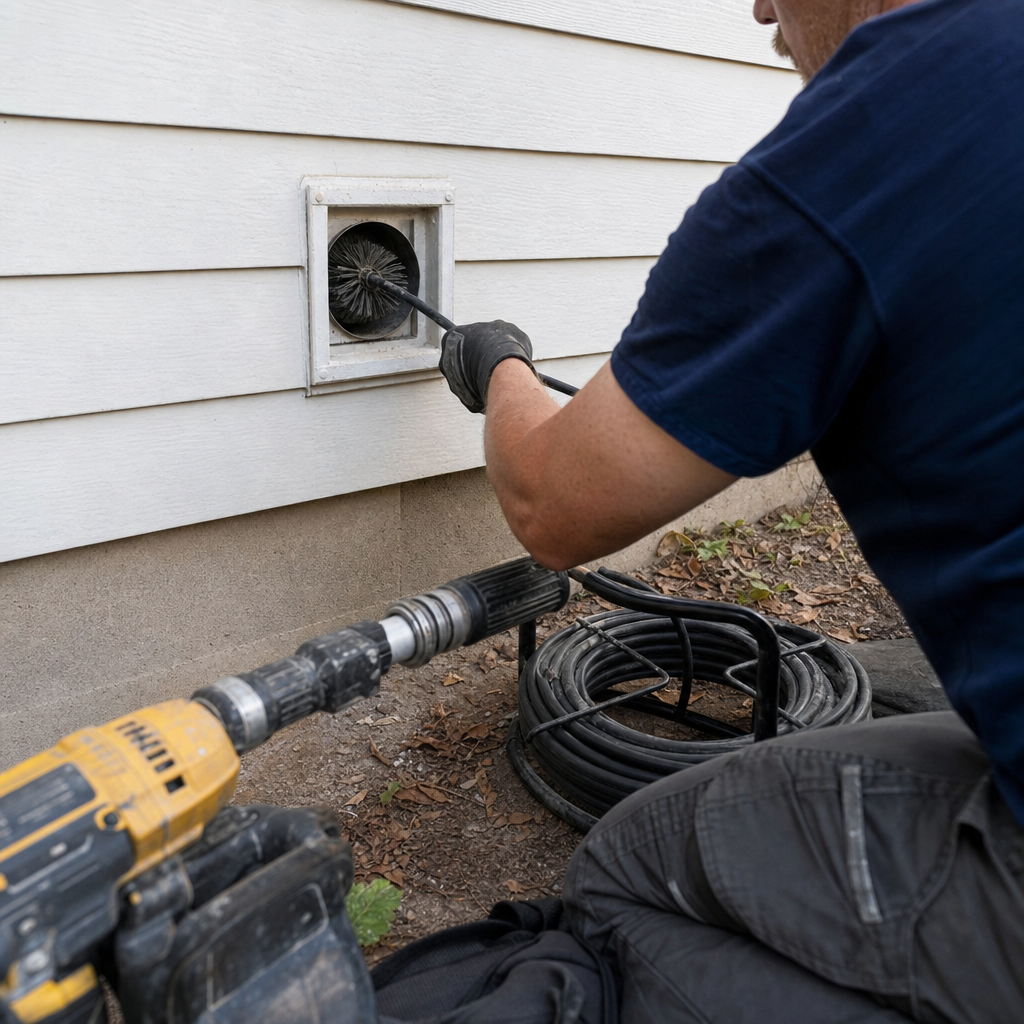
Our professional-grade Rotobrush and Nikro systems handle this differently than residential-grade equipment. The Rotobrush contact-cleans the duct wall with a rotating brush head that physically dislodges compressed lint, while the Nikro negative-pressure vacuum pulls it out rather than pushing it deeper. For long runs with multiple elbows, we also use compressed air whipping tools that navigate corners shop-vac hoses can’t manage. This isn’t a quick pass — it’s systematic restoration of designed airflow.
What Atlas Inspects During a Dryer Vent Cleaning
Cleaning alone doesn’t solve every vent problem. That’s why our service includes inspection of the full run, from dryer connection to exterior terminus. Here’s what we’re looking for — and what changes whether cleaning is enough.
| Inspection Finding | What It Means | Solution |
|---|---|---|
| Crushed or kinked flexible duct | Permanent airflow restriction; cleaning won’t restore shape | Replace with rigid smooth-wall duct |
| Disconnected joint inside wall or floor | Lint dumping into building cavity; moisture damage risk | Reconnection with proper supports and sealing |
| Bird nest or rodent debris at exterior cap | Complete or partial blockage; fire and pest risk | Removal and installation of pest-proof cap |
| Missing or damaged backdraft damper | Cold air infiltration; pest entry; lint blowback in wind | Replace with proper vent cap assembly |
| Lint packed at elbows or terminus | Normal accumulation for run length and age | Thorough mechanical cleaning with brush and vacuum |
We document findings with photos when accessible, so Kansas homeowners see what we see. No upsell, no mystery — just what’s actually in your vent and what it’ll take to fix it. From cleaning to repair to sanitizing — handled in one visit, with Henry Wood on the job personally.
How Often Should Kansas Homeowners Clean Dryer Vents?
Based on 17 years of service across the metro, here’s our practical guidance:
- Straight run under 10 feet, 1-2 elbows: Every 2-3 years with normal use (4-6 loads weekly)
- Run 15-25 feet, 2-3 elbows: Every 12-18 months; annual if you have pets or wash heavy items frequently
- Foil flex duct of any length: Inspect annually, replace with rigid duct regardless of cleaning schedule
- After any renovation: Construction dust infiltrates dryer vents through pressure changes and open windows; clean even if recently serviced
These intervals assume you’re cleaning the lint trap every load. A clogged lint screen sends more debris into the vent and cuts these timelines in half.
FAQs
If you’re wondering How Much Does Dryer Vent Cleaning Cost? (2026 Price Guide) — Kansas, KS, typical service runs $120-$220 for a standard residential run, with longer or more complex configurations reaching $250-$340 if replacement ductwork or pest-proof caps are needed. We provide upfront pricing before starting work — no surprises when we’re done. Call (855) 595-7944 for an exact quote; estimates are free.
DIY dryer vent cleaning kits cost $20-$40 but rarely reach past the first elbow and often compact lint deeper into the run rather than removing it. For Kansas City homes with long interior vent runs, Best Dryer Vent Cleaning in Kansas, KS with Rotobrush contact-cleaning and negative-pressure extraction is the only method that actually clears the full system. The cost of professional service is minor compared to a dryer replacement or fire damage; call (855) 595-7944 to discuss what’s right for your home.
We schedule same-day and next-day appointments throughout Kansas, Kansas and the broader metro when the vent shows emergency signs — burning smell, thermal cutoff activation, or visible smoke. For early-stage symptoms, we typically book within 48 hours. Either way, Henry Wood arrives as the lead technician with professional-grade equipment, not a dispatched crew member. Call (855) 595-7944 to check today’s availability.
If your vent uses foil accordion duct, has crushed sections, or has disconnected joints inside walls, cleaning alone won’t solve the problem — replacement is necessary for safety and code compliance. During our inspection, we camera-check or visually examine the full run to determine which applies. Many Kansas homes built before 1990 need partial or full duct replacement; we’ll show you exactly what we found and why. Call (855) 595-7944 for a no-pressure assessment.
When to Call Atlas Air Duct & Vent Cleaning Kansas
If your clothes are coming out hotter than they used to, if you catch a brief burning smell at cycle start, or if that exterior flapper barely flutters anymore, your vent is telling you something. Listen before the dryer starts telling you with failed cycles and safety shutdowns.
Atlas Air Duct & Vent Cleaning Kansas serves homeowners across Kansas, Kansas and the full metro with 17 years of specialized experience, professional-grade Rotobrush and Nikro equipment, and Henry Wood on every job as owner and lead technician. Our 276 customers reviewed us at 4.8 stars — not because we’re the cheapest, but because we show you what’s actually in your system and fix it properly.
If you’d rather have it looked at, Atlas Air Duct & Vent Cleaning Kansas offers Affordable Dryer Vent Cleaning in Kansas, KS with a no-pressure assessment — call (855) 595-7944 for a free estimate.
Written by Henry Wood, Owner & Lead Technician at Atlas Air Duct & Vent Cleaning Kansas, serving Kansas, KS.